
Algorab (δ Corvi) is a white A0 subgiant lying 86.9 light-years from the Sun, with an apparent magnitude of 2.94 and a surface temperature near 10,400 K, roughly 69 times more luminous than the Sun. It spins fast, at a projected rotational velocity of 236 km/s, and it is a wide visual double: a companion orange dwarf of magnitude 9.3 shares its proper motion at a physical separation of at least 640 astronomical units. The four principal stars of Corvus, Gamma (Gienah), Delta (Algorab), Epsilon (Minkar), and Beta (Kraz), form a compact lopsided quadrilateral in the southern spring sky. Corvus is one of forty-eight constellations catalogued by Ptolemy in the Almagest, and one element of an inseparable astronomical triad: Hydra the Water-Snake, the longest constellation in the sky, carries the Crow and the Cup (Crater) on its back. A line extended from Gienah through Algorab points directly to Spica in Virgo. Corvus covers only 184 square degrees, ranking seventieth in size among the eighty-eight modern IAU constellations.
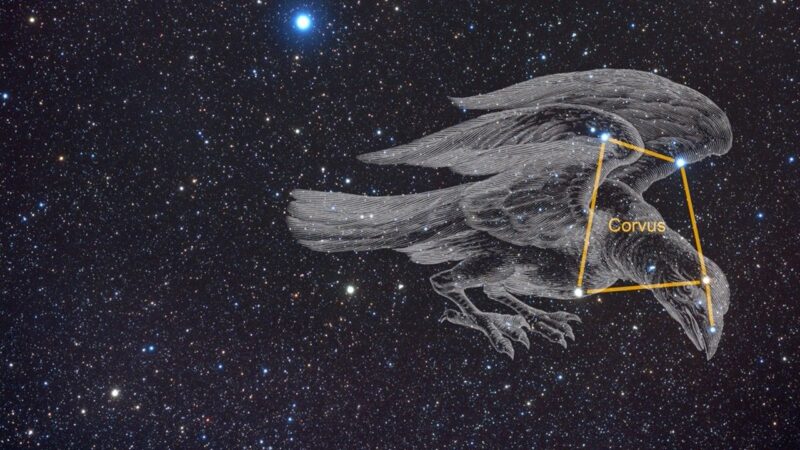
Gienah (Gamma Corvi) preserves the Arabic al-janāḥ, “the wing,” from the fuller phrase al-janāḥ al-ghurāb al-yamān, “the right wing of the raven.” Algorab derives from the separate Arabic word al-ghurāb, “the crow” or “the raven” itself; in the Alfonsine Tables both names were associated with Gamma, and Algorab migrated to Delta Corvi in the course of the medieval and Renaissance transmission of Arabic star catalogues into Latin. Vivian Robson, following this convention, places Algorab “on the right wing, and at the upper left corner of the square” of the constellation.
The constellation was known in Sumer as MUL UGA-MUŠEN, written in Akkadian as erēbu, referring to a rook, jackdaw, crow, or raven. With the ancient Chinese it was the Red Bird, the last constellation in their zodiac. In the valley of the Euphrates there was a connection between Tiamat, the Serpent of Night, and the Demon Ravens; the constellation was known there as the Great Storm Bird, the Bird of the Desert, the Bird of the Great Seed, and Storm Wind. The constellation also carries the Latin names Avis Ficarius, the Fig Bird, and Emansor, one who stays beyond his time, both derived from the myth that placed it in the sky.
On both Greek and Babylonian star-maps the Raven occupies the end of the Serpent’s tail, though their orientations differ: the Babylonian figure faces east, as illustrated on one of the Uruk tablets, while the Greek Corvus looks westward toward the Cup. Aratus describes the Greek arrangement: “Midway on its coil from Hydra is set the Crater and at the tip the figure of a Raven that seems to peck at the coil.” Gavin White, in Babylonian Star-Lore, notes that some references in astrological literature imply the Babylonian figure was larger than its Greek counterpart, with its tail extending into the stars of Crater, and argues that the Raven was originally fashioned to represent the final weeks of the summertime drought, a meaning faithfully preserved in Greek star-lore where the raven was sent by Apollo to fetch water and delayed at a fig tree until the fruit ripened. Through precession, by the late third millennium BCE the constellation rose at the start of the rainy season rather than at the end of summer, and Babylonian astrologers reformed its symbolic nature accordingly, attributing it to Adad, the god of rain and storm. A large number of the Raven’s omens concern rain and floods: “If the Raven’s stars are very bright: Adad will bring an abundance of rain.” Adad’s wife, Šala, appears on the Babylonian star-map placed right next to the Raven; under the name of the Furrow she is the direct precursor of Virgo, representing barley fields ready for the autumnal seeding. A representation of Mercury was placed between Šala and the Raven on the star-map, an association White notes has survived into modern astrology where Mercury’s exaltation falls in Virgo.
The Raven’s omen literature was richer than that of almost any other star, and much of it rests on wordplay. The Akkadian word for raven, erēbu, is nearly indistinguishable from erbû (locust) in syllabic spelling, generating the omen “if the Raven passes over the Seed-Furrow: locusts will rise up.” The Raven was sometimes confounded with the Death Star (MUL Ug-ga), a name commonly used for Saturn, which White suggests may inform the Raven’s more malevolent omens: “If the Raven’s star is not very red: epidemic will strike.” Several omens link the Raven to business and the commodity markets: “If the Raven disappears in the north: the market will be strong, sesame will thrive”; “If the Raven reaches the Path of the Sun (Saturn): business will diminish; there will be clamour.” A second wordplay underlies these market omens: erēbu is also sufficiently similar to erbu (income, revenue) to suggest an underlying link. The signs used to write the Raven’s name could themselves be read as the sequence plant, herb, grain, milk, a set of primary market commodities White suggests may have further contributed to the bird’s omen associations with trade.
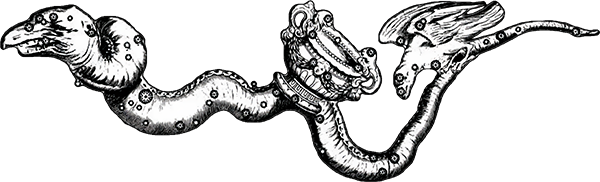
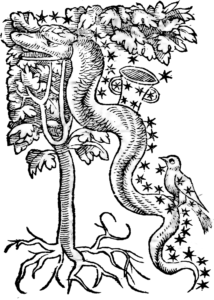
The myth that the Greeks used to explain Corvus, Crater, and Hydra together concerns Apollo. Its earliest surviving prose account is in the Catasterismi attributed to Eratosthenes, chapter 41, though Theony Condos’s commentary notes that no Greek authority earlier than the Catasterismi refers to the myth of the crow and the figs. The fullest Latin account is Ovid’s Fasti, Book II. Apollo, preparing a solemn sacrifice to Jupiter, sends his bird with a golden bowl to fetch water from a running spring. The crow takes the bowl and flies off, but finds a fig tree loaded with unripe fruit. The bird tries the figs with his beak, finds them unfit, and then unmindful of his orders perches beneath the tree and waits. After having eaten his fill of figs, the crow seizes a water-snake (Hydra) from beside the spring, and blames the snake for blocking the water. Apollo, the god of prophecy, sees through the lie immediately and curses the crow: as long as figs hang milky and unripe on the tree, the crow shall drink from no cool spring. Hyginus, in De Astronomica II.40, preserves a detail found in no other surviving source: after the crow returns with the snake, “the Crow appears to be shaking Hydra’s tail with his beak, in order to gain access to the Water-Cup.” This is the textual origin of the iconography showing Corvus pecking at Hydra’s tail, standard in the Ratdolt 1482 woodcut of the Poeticon Astronomicon and in subsequent Renaissance star atlases. All three figures, bird, bowl, and snake, are fixed together in the sky as a permanent memorial, and Pliny the Elder records that crows fall silent during the ripening of figs, the mythological curse absorbed into Roman natural history. The constellation Corvus sets before dawn during the height of summer, invisible precisely during fig-ripening season.
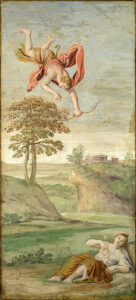
A second and older strand of the myth concerns the crow’s original color. The bird of Phoebus was once white: “white as any dove, white-feathered, snow-white as the geese that guard with watchful cries the Capitol: as white as swans that haunt the streams.” Coronis, daughter of Phlegyas, was Apollo’s lover. In Ovid’s telling, Apollo’s raven (corvus) observes her lying with Ischys the Thessalian and flies at once to report it. On the way he is intercepted by the garrula cornix, the chattering crow sacred to Minerva, who warns him against carrying tales, as she herself was once punished for doing so. The raven ignores her. Phoebus hears the news, drops his plectrum and his laurel, and shoots Coronis with an arrow. As she dies she tells him she is carrying his child. He repents, attempts to heal her, fails, and rescues the unborn Asclepius from her funeral pyre. The raven, punished by Apollo, is scorched black. In Pindar’s third Pythian ode, the earliest surviving treatment of the cycle, Apollo learns of the infidelity through his own omniscience, “his unerring counsellor, his mind, which knows all things.” The raven enters the tradition with the Hesiodic Ehoiai fragment preserved in the scholia to Pindar, where it is stated that Apollo learned of the matter from a raven, which carries into Hellenistic mythography as the same crow who becomes the constellation. Manilius in the Astronomica calls Corvus simply the bird sacred to Phoebus, and Goold’s note on the passage confirms that Apollo adopted its shape to elude Typhon when the gods fled to Egypt, citing Apollodorus (Bibliotheca 1.6.3) and Ovid (Metamorphoses 5.329). In this variant the constellation memorialises an apotropaic divine epiphany, the god himself inhabiting the bird’s form to escape destruction.
The structure of these Greek tales connects to a pattern visible across cultures wherever the corvid appears as sacred messenger. Paul Radin’s The Trickster: A Study in American Indian Mythology, extended its analysis from the Winnebago Wakdjunkaga cycle to Raven, Coyote, and Hare cycles across the continent. In Radin’s formulation, “Trickster is at one and the same time creator and destroyer, giver and negator, he who dupes others and who is always duped himself. He wills nothing consciously. At all times he is constrained to behave as he does from impulses over which he has no control. He knows neither good nor evil yet he is responsible for both. He possesses no values, moral or social, is at the mercy of his passions and appetites, yet through his actions all values come into being.” Lewis Hyde’s Trickster Makes This World (1998) developed this further, proposing that the corvid trickster belongs to the same morphological family as Hermes the cattle-thief and Prometheus the fire-thief: Raven on the Northwest Coast, the Norse Huginn and Muninn scouting for Odin, and the white raven of Apollo all participate in the same pattern, where the bringing of knowledge, light, or fire to humanity is structurally a theft from the hoarding god, ratified after the fact as a gift.
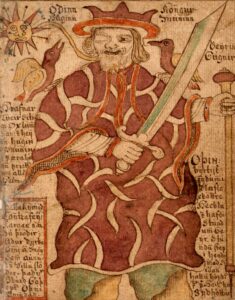
In the Norse tradition Odin’s ravens Huginn (Thought) and Muninn (Memory) are sent out each dawn to fly the nine worlds and return with intelligence. Grímnismál 20 preserves Odin’s own words: “I fear for Hugin that he will not come back, but I fear more for Munin.” Snorri Sturluson adds that the ravens sit on his shoulders and speak into his ear all the news they see or hear, hence his epithet, Hrafnaguð, Raven-god. In Genesis 8:6-7, Noah sends a raven from the ark first; it flies to and fro and does not return. The dove follows and comes back with an olive leaf. The raven thus becomes characterized as an unreliable soul, with the dove as the faithful messenger.
In Ireland, the war-goddess most closely associated with the corvid is the Mórrígan and her sister-figure Badb, whose name means “crow” and who appears in the texts as Badb Catha, “battle-crow.” In the Ulster Cycle she appears to Cú Chulainn as a black bird on a branch, foretelling: “It is at the guarding of thy death that I am; and I shall be.” In the eighth-century Aided Con Culainn, the dying hero’s enemies dare not approach until “the Morrígan and her sisters, in the form of crows, land on his shoulder,” confirming his death. The corvid’s appearance on the battlefield is the goddess herself, present in her preferred form.
In the Chinese Shanhaijing and Huainanzi traditions the three-legged sun-crow (Sānzúwū, also Yangwu or Jinwu, “Golden Crow”) inhabits the sun and is shot down by the archer Hou Yi; the bird is an emblem of solar yang. The Japanese Yatagarasu, recorded in the Kojiki (712 CE) and Nihon Shoki (720 CE), is a divine guide sent by the sun-goddess Amaterasu to lead the future Emperor Jimmu through the mountains of Kumano to Yamato. The Korean Samjok-o, attested on Goguryeo tomb murals from the fourth century CE onwards, plays the same solar role. In Hindu sources the crow is bound to Yama, lord of the dead, and to the ancestors: the śrāddha rites for the deceased culminate in the offering of a piṇḍa (rice-ball) to crows, whose acceptance signals that the ancestors have received the offering and are at peace.
In English and Scottish folk tradition the corvid omen survived the Christian suppression of formal augury and migrated into popular ornithomancy. The magpie counting-rhyme “One for sorrow, two for joy,” whose earliest recorded form appears in John Brand’s Observations on Popular Antiquities (1780 supplement), runs: “One for sorrow, / Two for mirth, / Three for a funeral, / And four for a birth”; the longer version familiar today derives from Michael Aislabie Denham’s A Collection of Proverbs and Popular Sayings (1846). In alchemical tradition the raven became the standard emblem of the nigredo, the first stage of the opus magnum, in which the prima materia is mortified and reduced to a black mass before the white and red stages can begin; the image of the caput corvi appears in the Rosarium Philosophorum and the Splendor Solis among other emblematic texts.
Agrippa, in Three Books of Occult Philosophy, treats the crow as one of the primary birds of augury: “a crow will speak, carefully overhearing and stationed in their setting or flying from the right or left, speaking or chattering or silent, preceding and following, or passing waiting for arrival, or fleeing or departing. All must be carefully observed.” He cites Horapollo’s Hieroglyphics: “Twin crows signify marriages, because this animal bears two eggs from which a male and female must be born. However, if (and this is rare) two males or two females are born, the males will not couple with females or mix with other crows. Likewise, females with other males, but will only continue estranged. Therefore, if meeting a single crow, this augurs for the future that one will live their life as a widow.” Ravens, Agrippa notes, foretell the future in the manner of crows; Epictetus the Stoic held that a raven croaking opposite someone would portend adversity to the body, fortune, honor, wife, or children.
Cicero’s De Divinatione preserves the technical Roman distinction between alites, birds whose flight gives the sign, and oscines, birds whose voice gives the sign; ravens and crows belong to the second class, and Cicero records the rule that the raven is auspicious on the right and the crow on the left. Omen significance depended on quadrant: a crow on the left and a raven on the right were auspicious, but the same birds in the wrong quadrant of the augur’s templum inverted the omen. Augustine, writing two and a half centuries after Cicero, mocks: “Cicero the augur laughs at auguries, and reproves men for regulating the purposes of life by the cries of crows and jackdaws” (City of God 4.30).
The corvid family (Corvidae, which encompasses crows, ravens, rooks, jackdaws, magpies, and jays) has emerged over the last quarter-century as one of the principal model groups in the study of animal intelligence. A female New Caledonian crow named Betty, deprived of the hooked wire she normally used to retrieve food, spontaneously bent a straight piece of wire into a functional hook: the first documented case of an animal purposefully reshaping a novel material into a tool. Ravens can plan for future needs and delay gratification for up to seventeen hours. Scrub-jays not only remember what they cached, where, and when, but re-hide food when they know they have been watched, and keep track of which individual saw which cache. After researchers wearing a particular mask trapped and banded crows on a Seattle campus, those crows and their offspring scolded anyone wearing that mask for years afterward, transmitting the association to birds that had never been trapped themselves. Ravens in the wild use gesture to show and offer objects to specific partners and wait for a response, a behaviour previously documented only in great apes.
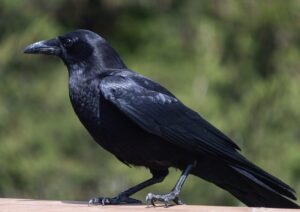
Seweryn Olkowicz and colleagues showed that corvid brains contain on average twice as many neurons as primate brains of the same mass, packed into a much smaller space. A common raven brain weighing 14.13 grams contains 2.17 billion neurons, more than a capuchin monkey brain despite being a fraction of the size. The corvid mind turns out to be a genuine case of advanced cognition evolved on a completely different neural architecture than our own, lending resonance to the persistent association of crows and ravens, in mythologies from Apollo’s messenger to Odin’s Huginn and Muninn (“thought” and “memory”), with insight, foresight, recognition, and speech.
In the Indian Vedic system the five principal stars of Corvus constitute the thirteenth nakshatra, Hasta, “the Hand,” spanning 10°00′ to 23°20′ Virgo. Prash Trivedi, in The Book of Nakshatras, notes that the ancient Vedic seers saw in this grouping the top of a hand, five fingertips spread skyward. Hasta’s main translation is “the hand,” with an alternative translation of “laughter” from the Sanskrit root Has. Its alternative names Bhanu and Ark translate as “Sun” and “Sun’s Ray.” The ruling deity is Savitar, “the impeller” and “the first rays of the rising Sun,” a solar deity always portrayed with a laughing gesture, said to be extremely skilled with his hands, and described by Trivedi as “a crafty trickster, taking pleasure in lying, gambling and fraud.” Savitar can be seen as a deity who fuses the energies of Sun and Mercury, and his qualities are very similar to those ascribed to the Budha-ditya yoga, the Sun-Mercury conjunction. Hasta’s three symbols are an open hand with all five fingers spread, relating to palmistry, fate, and the rays of the Sun; a clenched fist, exemplifying secrecy and determination, and in its negative aspect greed, ambition, and an inability to let go; and a potter’s wheel, symbolising the passage of time.
In the Tetrabiblos, Ptolemy assigns Corvus the nature of Mars and Saturn, the two malefics. Robson states that Corvus “is said to give craftiness, greediness, ingenuity, patience, revengefulness, passion, selfishness, lying, aggressiveness, and material instincts, and sometimes causes its natives to become agitators.” Of Algorab specifically he writes: “A double star, pale yellow and purple, situated on the right wing of the Crow. From Al Ghirab, the Crow. Of the nature of Mars and Saturn. It gives destructiveness, malevolence, fiendishness, repulsiveness and lying, and is connected with scavenging.”
Rosenberg, in Secrets of the Ancient Skies, treats Algorab within the star zone she calls the wing of the Crow and China’s Great Red Bird, combined with tropical Libra’s element of air and the Virgin’s realm of discerning intellect. She finds a strong theme of those who are tremendously gifted, with curious, inquiring minds and a willingness to constantly learn, fascinated with language, folklore, and the sounds of other cultures, often becoming philologists; those with technical and scientific abilities who become guardians of tradition and preservation of ancient knowledge. The shadow expression runs to those who are “self-righteous ‘holier-than-thou’ zealots” persecuting those who do not adhere to their ideas of morality, or to “greedy, scavenging, dishonest” natures lashing out without cause. She further records that the figure of Corvus originally represented one of the malignant brood of the archaic Babylonian sea-monster Tiamat, the embodiment of moral evil and the darkness of night, destroyed by the Sun; her other offspring were Cetus the Sea-Monster, Hydra the Water-Snake, Scorpio, Canis Major, and Lupus the Beast of Death.

Among the fifteen Behenian fixed stars the Wing of the Crow holds the eighth position. The Liber Hermetis de Quindecim Stellis gives the star entry: “The eighth star is called Ala Corvi, and it doth not shine so much as some others of which we made mention above; for it is of the nature of Saturn and Mars, and keepeth in itself many evil significations: and because it is full of misfortune, when the infortunes should be therewith, it signifieth every evil the signification of which Saturn and Mars possess. And if the Moon should be with it, thou wilt declare it to be in an exceedingly evil signification. Now unless it should be that the fortunes, namely, the Sun, Jupiter and Venus, go to meet it, thou wilt place this star in a work of destruction. ” Agrippa’s prescription in De Occulta Philosophia gives the talismanic image: “Under the Wing of the Raven they made images of a raven, serpent, or a black man dressed in black garments: these make men angry, bold, courageous, thoughtful, a slanderer, and give evil dreams. They also give the ability to make daemons flee and gather. They are useful against wicked men, daemons, and winds.”

Onyx (onychinus) is the talismanic stone given to Algorab. Pliny records a stone with a white portion resembling a human fingernail set against darker colors, ranging from fiery Indian varieties with white veins to solid black Arabian onyx encircled in white. The medieval tradition is consistent in its character: worn at the throat or on the finger, onyx induces sorrow, fear, and terrible dreams. As Albertus Magnus explains, “all these disorders come from the motion and vapour of black bile.” A stag or viper carved on an onyx gives its wearer courage, calls demons together and sends them fleeing, and calms evil winds. In dream necromancy it allows the sleeper to speak with the dead and remember what they need upon waking. Hildegard of Bingen shares a gentler use: “If you are oppressed with sadness, look at an onyx intently, then place it in your mouth. The oppression of your mind will cease.”
Greater Burdock (Arctium lappa, Asteraceae) is the Behenian herb of Ala Corvi. Most herbalists assign it to Venus; Schulke gives the fullest attribution, placing it under both Venus and Saturn: “It is aligned with Venus and Saturn, and its powers in magic are Wealth, Love, Vigor, Healing, and Protection from Maleficia.” The root is a traditional blood purifier and diuretic, used in decoctions to cleanse the blood and treat skin disorders. Folkard records an Albanian folk belief that if a man has been influenced by the demons of the forest, the evil spirit must be exorcised by the priest, with a portion of the ceremony consisting of the steeping of bread in wine and the spreading of it on the broad leaves of a burdock. Cunningham prescribes casting burdock roots around the home to ward off negativity, stringing them on red thread for protection against evil. In Scotland the spiky pods of two species of burdock comprise the hoary mantle of the Burry Man, who appears each year on the second Friday in August in the vicinity of South Queensferry, Lothian, adorned head to toe with pods of burdock while wearing a bowler and a reversed balaclava. Attendants walk the town boundaries with him as he collects money, whisky offered to him through a straw at each stop; some believe him a modern manifestation of the errant spirit of the Green who wanders the land spreading fecund blessings, others suspect the rite descended from the ancient tradition of the scapegoat. Cornish folk wisdom explains the downy burdock tufts as remnants of fairy-folk who ride about on ponies and strew them from their manes.
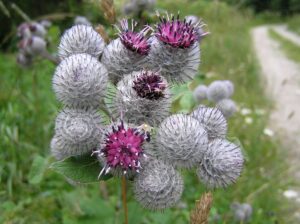
Müller-Ebeling, Rätsch, and Storl document burdock as a bear plant, sacred to Thor. It was placed in the gables of houses to protect against lightning strikes and the machinations of giants, and as late as the Enlightenment farmers hung burdock over their doors and braided it into their hair or a cow’s tail to ward off evil. Many sought the mysterious midsummer coal beneath the burdock roots at noon on the longest day of the year; those who dared pick it up with their bare hands would be spared bad luck and sorrows.
The tongue of a frog is the final listed materia in the talismanic prescription. The frog and its various parts have a long history of use in magical practice, but the tongue specifically is mentioned several times in the technical hermetica as a spell ingredient. It appears in the Kyranides twice, enclosed in a gold signet with cinnamon and musk in one instance, and bound with a hawk’s tongue, a loadstone, and steel filings in another; both are amulets for health and protection, though the texts are fragmentary and portions remain untranslated. A second Kyranides passage claims for the completed amulet the power of foreknowledge. In the Betz translation of the PGM the frog tongue appears twice more, interestingly linking this materia to Apollo and to Hermes. PGM X.36-50, titled “Apollo’s charm to subject,” directs the operator to take a metal lamella from a yoke for mules, engrave divine names on it, and place a frog’s tongue within it, invoking Apollo to dominate a troublemaker. PGM V.172-212 includes a frog’s tongue offered on the altar as part of a purificatory sacrifice invoking Hermes as finder of thieves. The newer GEMF edition of the magical papyri identifies additional instances: in GEMF 51 the tongue appears in a charm invoking Hekate-Selene, cut from a living frog and thrown back into the water during the rite, and the editors note the ingredient’s further appearance in a curse (GEMF 68).
The thread running through the entire tradition, from the Babylonian Raven of Adad through the Apolline crow turned black for tale-bearing through the Hermetic talisman against men, daemons, and evil winds, is a particular quality of perception: acute, watchful, morally double, capable of both service and betrayal. The crow sees what others miss and reports it at his peril. Modern cognitive science has given this reputation empirical grounding: the long memory for faces, the foresight that plans across temporal delays, the social intelligence that tracks who saw what and when, the referential gesture offered to a specific partner and no other. These are the capacities that made the crow the natural instrument of the prophetic god, the scout of Odin, the battle-presence of the Mórrígan. Cunning and foresight in the corvid are observed behaviors fundamental to their nature and myth.
The talismanic effects prescribed under Ala Corvi follow from the star’s mythology. They make the bearer wrathful, bold, courageous, evil of thought and evil of speech. Taken out of context these read as a catalog of vices, but the same list explicitly includes the power to drive away evil spirits and protect against them: “it giveth the power of driving away evil spirits, and of gathering them together; it is profitable against the malice of Men, Devils and Winds.” These are the qualities this type of work demands. Boldness and controlled aggression are some of the greatest assets in works of exorcism and daemonic control. Ala Corvi, when the fortunes go to meet it, turns the crow’s perceptiveness and cunning outward. The Raven-god’s bird, scorched black for knowing too much and saying so, becomes the instrument of one who would speak to what is present in the darkness and bind it to her will.
References
- Agrippa, Heinrich Cornelius, Three Books of Occult Philosophy, trans. Eric Purdue. Rochester, VT: Inner Traditions, 2021.
- Ahn Hwi-Joon, “Development of Goguryeo Tomb Murals,” International Journal of Korean Art and Archaeology 9 (2015).
- Albertus Magnus, Book of Minerals, trans. Dorothy Wyckoff. Oxford: Clarendon Press, 1967.
- Aided Con Culainn, cited in Eleanor Hull, ed., The Cuchullin Saga in Irish Literature. London: David Nutt, 1898.
- Aratus, Phaenomena, cited in Bernadette Brady, Brady’s Book of Fixed Stars. York Beach, ME: Samuel Weiser, 1998.
- Augustine, De Civitate Dei, trans. Marcus Dods. Edinburgh: T. & T. Clark, 1872.
- Betz, Hans Dieter, ed., The Greek Magical Papyri in Translation. Chicago: University of Chicago Press, 1986.
- Brand, John, Observations on Popular Antiquities. Newcastle: T. Saint, 1777; supplement 1780.
- Cicero, De Divinatione, trans. W. A. Falconer. Loeb Classical Library 154. Cambridge, MA: Harvard University Press, 1923.
- Clayton, Nicola and Anthony Dickinson, “Episodic-like memory during cache recovery by scrub jays,” Nature 395 (1998): 272-274.
- Cornell, H., John Marzluff, and V. Pecoraro, “Social learning spreads knowledge about dangerous humans among American crows,” Proceedings of the Royal Society B 279 (2012): 499-508.
- Culpeper, Nicholas, Complete Herbal. London, 1653.
- Cunningham, Scott, Encyclopedia of Magical Herbs, 2nd ed. St Paul: Llewellyn, 1985.
- Dally, Joanna, Nathan Emery, and Nicola Clayton, “Food-caching western scrub-jays keep track of who was watching when,” Science 312 (2006): 1662-1666.
- Denham, Michael Aislabie, A Collection of Proverbs and Popular Sayings Relating to the Seasons, the Weather, and Agricultural Pursuits. London: Percy Society, 1846.
- Emery, Nathan and Nicola Clayton, “Effects of experience and social context on prospective caching strategies by scrub jays,” Nature 414 (2001): 443-446.
- Faraone, Christopher A. and Sofía Torallas Tovar, eds., Greek and Egyptian Magical Formularies: Text and Translation, vol. 1. California Classical Studies 9. Berkeley: California Classical Studies, 2022.
- Folkard, Richard, Plant Lore, Legends, and Lyrics. London: Sampson Low, 1884.
- Genesis 8:6-7; Genesis Rabbah 33:5.
- Green, Ashleigh, Birds in Roman Life and Myth. Global Perspectives on Ancient Mediterranean Archaeology 1. New York and London: Routledge, 2023.
- Hesiod, fr. 60 Merkelbach-West, in the scholia to Pindar Pythian 3.48.
- Hildegard of Bingen, Physica, trans. Priscilla Throop. Rochester, VT: Healing Arts Press, 1998.
- Huainanzi, trans. John S. Major et al. New York: Columbia University Press, 2010.
- Hunt, Gavin, “Manufacture and use of hook-tools by New Caledonian crows,” Nature 379 (1996): 249-251.
- Hyde, Lewis, Trickster Makes This World: Mischief, Myth, and Art. New York: Farrar, Straus and Giroux, 1998.
- Hyginus, De Astronomica, trans. Theony Condos, in Star Myths of the Greeks and Romans. Grand Rapids: Phanes Press, 1997.
- Kabadayi, Can and Mathias Osvath, “Ravens parallel great apes in flexible planning for tool-use and bartering,” Science 357 (2017): 202-204.
- Kojiki, trans. Donald L. Philippi. Princeton: Princeton University Press, 1969.
- Kunitzsch, Paul and Tim Smart, A Dictionary of Modern Star Names, 2nd ed. Cambridge, MA: Sky Publishing, 2006.
- Lecouteux, Claude, A Lapidary of Sacred Stones, trans. Jon E. Graham. Rochester, VT: Inner Traditions, 2012.
- Liber Hermetis de Quindecim Stellis, in De Quindecim Stellis: The Comprehensive Translations of Hermes on the Fifteen Fixed Stars. Lulu Press, 2022.
- Manilius, Astronomica, trans. G. P. Goold. Loeb Classical Library 469. Cambridge, MA: Harvard University Press, 1977.
- Marzluff, John et al., “Brain imaging reveals neuronal circuitry underlying the crow’s perception of human faces,” PNAS 109 (2012): 15912-15917.
- Marzluff, John et al., “Lasting recognition of threatening people by wild American crows,” Animal Behaviour 79 (2010): 699-707.
- Müller-Ebeling, Claudia, Christian Rätsch, and Wolf-Dieter Storl, Witchcraft Medicine, trans. Annabel Lee. Rochester, VT: Inner Traditions, 2003.
- Nelson, Sarah M., The Archaeology of Korea. Cambridge: Cambridge University Press, 1993.
- Nihon Shoki, trans. W. G. Aston. London: Kegan Paul, 1896.
- Olcott, William Tyler, Star Lore: Myths, Legends, and Facts. New York: Dover, 2004.
- Olkowicz, Seweryn et al., “Birds have primate-like numbers of neurons in the forebrain,” PNAS 113 (2016): 7255-7260.
- Ovid, Fasti II, trans. James George Frazer. Loeb Classical Library 253. Cambridge, MA: Harvard University Press, 1931.
- Ovid, Metamorphoses II, trans. Brookes More. Boston: Cornhill Publishing Co., 1922.
- Pika, Simone and Thomas Bugnyar, “The use of referential gestures in ravens (Corvus corax) in the wild,” Nature Communications 2 (2011): 560.
- Pindar, Pythian III, trans. William H. Race. Loeb Classical Library 56. Cambridge, MA: Harvard University Press, 1997.
- Pliny the Elder, The Natural History, trans. John Bostock and H. T. Riley. London: Henry G. Bohn, 1855.
- Pseudo-Eratosthenes, Catasterismi, trans. Theony Condos, in Star Myths of the Greeks and Romans. Grand Rapids: Phanes Press, 1997.
- Ptolemy, Claudius, Tetrabiblos, trans. J. M. Ashmand. London, 1822.
- Radin, Paul, The Trickster: A Study in American Indian Mythology, with commentaries by Karl Kerényi and C. G. Jung. New York: Philosophical Library / Schocken Books, 1956.
- Robson, Vivian E., The Fixed Stars and Constellations in Astrology. London: Cecil Palmer, 1923.
- Rosenberg, Diana K., Secrets of the Ancient Skies: Fixed Stars and Constellations in Natal and Mundane Astrology, vol. 2. New York: Ancient Skies Press, 2012.
- Schulke, Daniel A., Green Mysteries: The Secret Lore of Growing Things. Hercules, CA: Xoanon, 2021.
- Shanhaijing (Classic of Mountains and Seas), trans. Anne Birrell. London: Penguin, 1999.
- Stahler, Daniel, Bernd Heinrich, and Douglas Smith, “Common ravens, Corvus corax, preferentially associate with grey wolves, Canis lupus, as a foraging strategy in winter,” Animal Behaviour 64 (2002): 283-290.
- Táin Bó Cúailnge: Recension I, ed. and trans. Cecile O’Rahilly. Dublin: Dublin Institute for Advanced Studies, 1976.
- Trivedi, Prash, The Book of Nakshatras. Mumbai: Sagar Publications, 2005.
- Weir, Alex, Jackie Chappell, and Alex Kacelnik, “Shaping of hooks in New Caledonian crows,” Science 297 (2002): 981.
- White, Gavin, Babylonian Star-Lore, rev. ed. London: Solaria, 2008.