


‘Tis the tempestuous loveliness of terror;
For from the serpents gleams a brazen glare
Kindled by that inextricable error,
Which makes a thrilling vapour of the air
Become aand ever-shifting mirror
Of all the beauty and the terror there—
A woman’s countenance, with serpent-locks,
Gazing in death on Heaven from those wet rocks.
–Percy Bysshe Shelley
Algol, also known as the Demon Star or Ra’s al Ghul (“Demon’s Head”), derives its name from the Arabic term for “mischief-maker” and is linked to the mythological Gorgon Medusa, beheaded by Perseus. The second-century astronomer Ptolemy labeled it as “the bright one in the Gorgon’s head” and designated it as being of the nature of Jupiter and Saturn. Algol was often seen as an ominous star by various cultures: Hebrew folklore calls it Rosh ha Satan (Satan’s Head), while Chinese astronomers named it Tseih She (Piled-up Corpses). Algol appears as Caput Larvae (Spectre’s Head) in medieval European texts and as the Gorgon’s Head in Greco-Roman sources.
The symbolism of Medusa and the Gorgons is layered with meanings that have evolved over time. In ancient Greece, the Gorgoneion—an image of Medusa’s head—was a powerful apotropaic symbol, often used to ward off evil. The Gorgoneion was used on shields and breastplates, such as that of Athena, who wore Medusa’s head on her aegis as a symbol of her own power. This image served a dual purpose as both a symbol of Athena’s martial prowess and a protective device, meant to strike fear into the hearts of her enemies.
The fearsome image of the Gorgon can also be seen as a reflection of societal fears surrounding feminine power. In patriarchal Greek society, powerful women were often portrayed as dangerous and threatening. The Gorgons, with their blend of beauty and monstrosity, represent the dual perception of women as both desirable and dangerous. Medusa, in this sense, can be viewed as a symbol of the chaotic, untamed aspects of femininity that threatened male-dominated social structures.
Julia Kristeva’s Powers of Horror (1982) develops the concept of the abject: that which “disturbs identity, system, order” and “does not respect borders, positions, rules.” The corpse is her paradigmatic example, death infecting life. Medusa is a vivid embodiment of abjection in this sense: her ability to petrify with her gaze enacts the horror of confronting what cannot be looked at directly. Her liminal status, suspended between beauty and monstrosity, victim and villain, life and death, makes her a potent symbol of the anxieties surrounding the boundaries of the self.
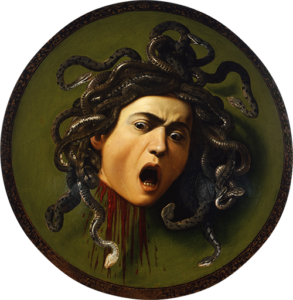
During the Renaissance, artists became fascinated with Medusa’s duality—her monstrousness and her beauty. Caravaggio’s Medusa (1597) famously captures the moment of her decapitation, her face frozen in a grimace of shock and agony, transforming her into a tragic, almost sympathetic figure. Similarly, the poet Percy Bysshe Shelley reinterpreted Medusa as a tragic heroine in his poem On the Medusa of Leonardo da Vinci in the Florentine Gallery. Shelley’s depiction evokes the Romantic fascination with beauty intertwined with horror, transforming Medusa into a symbol of sublime, otherworldly power.
Feminist theorists have also revisited Medusa’s myth, reclaiming her image as a figure of female resistance and rage. Hélène Cixous’s essay “The Laugh of the Medusa” (1975) argues that Medusa’s portrayal as a monstrous woman reflects male anxieties about female sexuality and autonomy. Cixous urges women to reclaim Medusa’s image, declaring, “You only have to look at the Medusa straight on to see her. And she’s not deadly. She’s beautiful and she’s laughing.” I personally reject this feminist lens that would seek to defang her, however, and find it incredibly dangerous to imbue victimhood with inherent virtuosity or innocence. Her deadliness is very real and should never be underestimated. To do so would be to rob her of her power, fullness, and complexity.
Cornelius Agrippa in his Three Books of Occult Philosophy says of talismans of Algol, “Under Caput Algol, they made an image whose figure was the head of a man with a long beard, having a bloody neck. This brought the good outcome of petitions, gave the bearer boldness and nobility, preserved members of the body from injury, helped against sorceries, and reflected evil attempts and evil incantations from enemies.” Hermes on The Fifteen Fixed Stars states, “Its virtue is to make a man great of heart, and it guardeth a man from sorcery. Its color is as iron polished and clear. And its virtue is greater when the Moon is with this star. Its herb is deadly Black Hellebore. If thou puttest a bit of this herb and an equal amount of Mugwort beneath Diamond when the Moon is with Algol, thou wilt have the power to judge as thou wouldst.”
I will admit I was initially hesitant to make talismans of this star due to its reputation but my personal philosophy towards art and magic is to always be open and receptive to the spirits, and when she came calling to me I knew I had to answer. The line between artistic inspiration and possession is often a extremely fine one, if it indeed exists at all. The working began with the acquisition of a black hellebore plant for my garden, the plant associated with Algol according to the traditional sources. The name “black hellebore” refers to species “helleborus niger” which is a winter-blooming evergreen perennial, also sometimes called Christmas Rose. As soon as I saw it, the associations became more clear.
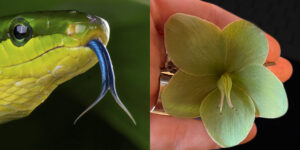
During the making of these talismans, which took place over several months, I also lost power to my home three times, with two of these outages lasting over six hours—longer than I had ever experienced previously. This is a common occurrence connected with talismans of Algol. For the design, I chose to use a large, rose-cut serpentine pear surrounded by snakes, hand-sculpted in jeweler’s wax and cast in solid sterling silver. Although diamond is the stone traditionally associated with Algol, it is extremely cost-prohibitive; instead, I chose serpentine, which I felt resonated with the nature of Algol. I was able to acquire genuine diamond dust, however, and the serpentine is set above a mixture of this and hellebore leaf.
During the electional window, Algol was rising on the ascendant with the Moon applying to conjoin. The Moon was waning, which is appropriate for removal—in this case, the removal of evil, witchcraft, and enemies. The Moon was fast, unafflicted, and dignified by exaltation and triplicity. Venus, the ruler of both the Moon and the ascendant, was dignified by rulership in Libra. The election is also further fortunated by the presence of the benefic Jupiter in the first house.
Talismans of Algol are believed to provide some of the strongest protection of any star due to her fearsome and terrifying nature. I have found this to be true as long as one treats Algol with the great respect she deserves. Her protection is not always kind, however, and one must keep in mind that she can also reveal the ways in which we project our own monstrosity upon others. She has also been known to provoke those around us to “lose their heads” or reveal to us their “true faces.” These experiences can often feel chaotic and destabilizing, but they are a necessary evil for those who wish to walk through the world in truth. She simultaneously provides a shield from the chaos that may erupt around us. The creation of these talismans was an incredibly transformative and beautiful experience that I hold deeply sacred.
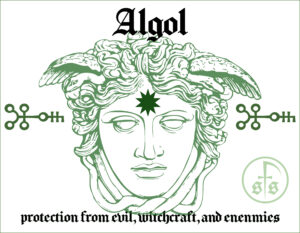
Only five talismans were made, of which four are available. Each talisman is approximately 1.75″ tall and comes on your choice of a 20″ sterling silver chain or black satin cord, accompanied by the devotional artwork pictured above, printed on cardstock. Each talisman contains slight variations due to its handcrafted nature and the use of natural stones, but it will be nearly identical to those pictured and intuitively selected. The talismans were enspirited with the intention of protecting the bearer from evil, witchcraft, and enemies.
Here is a playlist of resonant music which aided in their creation and can be used to further connect with their spirit.
May the daimon of these talismans protect you from evil, enemies, and witchcraft
References
- Agrippa, H. C. Three Books of Occult Philosophy. 1531.
- Cixous, H. “The Laugh of the Medusa.” Signs, vol. 1, no. 4, 1976.
- Hermes on The Fifteen Fixed Stars
- Kristeva, J. Powers of Horror: An Essay on Abjection. Columbia University Press, 1980.
- Shelley, P. B. “On the Medusa of Leonardo Da Vinci in the Florentine Gallery.” 1820.