


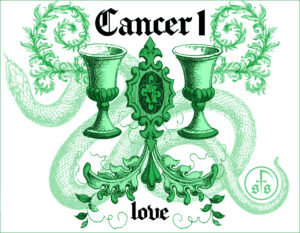
 The first face of Cancer begins with the summer solstice, the longest day of the year. In the oldest astrological arrangements of the Hellenistic period, Cancer was considered the first sign of the zodiac in the Thema Mundi, the horoscope of the universe itself. Cancer is the sign of the mother, and it is within the mother that all things begin.
In ancient Egyptian astronomy, this decan was known as Sepdet, called Sothis by the Greco-Egyptians. The Liber Hermetis names this face Seneptois. The first decan of Cancer is ruled by Venus according to Arabic and Western traditions. According to Johannes Angelus, this face is “of Venus and is a face of joy, subtility, humanity, courtesy, and of such things as induce men to love.” Agrippa describes the image as “a young virgin, adorned with fine clothes, and having a crown on her head; it giveth acuteness of senses, subtlety of wit; and the love of men.” The Picatrix states this is “a face of teaching, knowledge, of love, subtlety and of skills.”
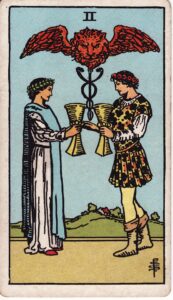 This decan corresponds to the Two of Cups in the tarot, the card of love and union. The Rider-Waite image depicts two lovers joining their chalices with a red lion rising from the united cups. The same themes of reciprocal nurturing and enmeshment appear across multiple traditions. Austin Coppock writes in The 36 Faces that “the energy circulates between the two participants. It is as if the two reside in each other’s wombs, simultaneously devouring and being devoured, yet neither is depleted. It is this miracle of entwined vessels that many long for when they dream of the love that will save and strengthen them.”
The Liber Hermetis describes this face as “a serpent joined with the face of a dog. In the tail however a heart like a pine cone. It has half of its tail turned down and from either part of the side of the heart slender serpents above the dog’s head.” The Sacred Book of Hermes to Asclepius offers a similar description: “a man with the head of a dog; his whole body has a spiral shape like that of a serpent. He is seated on a pedestal.” It prescribes engraving this image “on a dryite stone, place some artemisia plant under it, and wear it.” Giordano Bruno provides a clearer image: “a woman with a crown who is richly dressed. She in her right hand, an olive branch, in her left a chalice.”
T. Susan Chang observes in 36 Secrets that “the decan commentators vary wildly in their images of the spirit of this decan—yet there is a Venusian consistency of tone: A graceful woman holding a lotus, standing in the water. A man holding fruits and leaves standing among sandalwood trees. A handsome man with white feet in a fragrant orchard. A man covered in fig leaves with curved fingers. A prettily dressed virgin girl with a crown. Each approaches the world in a manner as delicate as the sea foam, expressing sharp senses, friendliness, cleanliness, love, and above all ‘subtlety.’”
The fragmentary Greek text The 36 Airs of the Zodiac places Nike, Winged Victory, in this decan. As the charioteer of Zeus, Nike governs the motion of the divine vehicle, an image of embodiment itself. The vision of Nike as charioteer speaks to the same biological processes of nourishment and strength that sustain the body as the soul’s vessel, mirroring the other images of reciprocal sustenance that define this face.
The design of these talismans was drawn from both the Liber Hermetis and Bruno’s descriptions, featuring an overflowing chalice encircled with a serpent. This design also references the Two of Cups, which depicts the Caduceus of Hermes. The intertwined serpent and vessel represent the circulation of energy between lovers, the reciprocal nourishment that defines this face.
The stone traditionally associated with this face in the Sacred Book of Hermes to Asclepius is dryite, a type of petrified oak. The text also prescribes artemisia, referring to mugwort or wormwood. I chose to use green jasper and peach moonstone, stones ruled by Venus and the Moon, set above oak wood, mugwort, and moss. Oak honors the traditional stone correspondence through its botanical form. Mugwort fulfills the prescribed artemisia and is sacred to Artemis and the Moon, reflecting Cancer’s lunar nature. Moss was chosen as the incense for this face according to the traditional sources. All three plants were personally foraged, with the mugwort gathered on St. John’s Eve, a time when it is considered most potent in folk tradition.
I elected these talismans using the following method outlined in the Picatrix: “Accordingly make the images of the faces when their rulers are present in them as this will perfect their effects in the World. And if by chance the Sun is rising in the hour of the planet or [is in aspect] the work will be stable and strong.”
The talismans were created on August 8, 2025. The Sun rose in the hour of Venus on the day of Venus, while Venus was in the first face of Cancer. Venus also applied to the benefic Jupiter. Although the Picatrix does not give explicit considerations for the moon for this particular election, it is still important to always ensure she is unafflicted. In this case she was unafflicted by hard aspects to malefics, waxing, fast in motion, also in Venus’s face in Aquarius, and exactly conjoined with the Part of Fortune.
During the electional window, the stones were engraved with the sigil of the first face of Cancer, suffumigated, and ritually enspirited for love. They were then set into pendants hand-sculpted in wax and cast in solid sterling silver above the herbs mentioned.
Each talisman measures approximately 1.75 inches tall and comes on your choice of black satin cord or oxidized sterling silver chain, along with a copy of the devotional artwork above printed on card stock. Only 9 were made.
May the daimon of these talismans grant you love
References
- Agrippa, Cornelius. Three Books of Occult Philosophy.
- Bruno, Giordano. De Umbris Idearum.
- Chang, T. Susan. 36 Secrets: A Decanic Journey through the Minor Arcana of the Tarot.
- Coppock, Austin. 36 Faces.
- Hermes on the 15 Fixed Stars (Liber Hermetis).
- Johannes Angelus. Astrolabium Planum.
- The Picatrix.
- The Sacred Book of Hermes to Asclepius.