


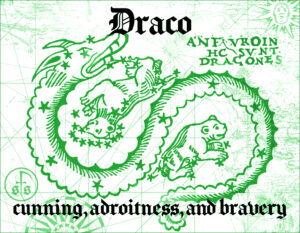
Draco is a northern constellation circling the celestial pole, winding between Ursa Major and Ursa Minor. Its name derives from the Latin for dragon, itself from the Greek drakon, a word for a great serpent whose root means “to see clearly,” often glossed as “the one who stares,” a reference to the creature’s watchful, guarding nature. The constellation once held the pole star. Around 2700 BCE, Thuban marked the axis of the heavens, and the creature rotated around the unmoving point of the world coiled in perpetual vigilance.
In Greek myth, Draco is most often identified with Ladon, the hundred-headed serpent who guarded the golden apples in the garden of the Hesperides. According to Apollodorus, Ladon was the offspring of Typhon and Echidna, or in other accounts of Phorcys and Ceto. He was placed by Hera to coil around the tree and never sleep. Heracles slew him as his eleventh labor, and the dragon was set among the stars. Hyginus in his Astronomica records another origin: that this was the serpent thrown at Minerva by the Giants during their war against the gods. She caught it mid-flight and hurled it into the heavens, where it remains twisted and knotted around the pole.
Richard Hinckley Allen in Star Names notes that the Babylonians may have seen here the dragon Tiamat, the primordial chaos serpent overcome by a kneeling sun-god. Stars now assigned to Draco appear in Egyptian astronomy as part of the Hippopotamus, depicted on the walls of the Ramesseum at Thebes and the tombs of Seti I and Senenmut. In China, stars from Draco form part of Zǐ Wēi Yuán, the Purple Forbidden Enclosure, representing the celestial palace of the Jade Emperor.
Ptolemy assigns the bright stars of Draco to the nature of Saturn, Mars, and Jupiter. Robson in Fixed Stars and Constellations in Astrology describes the constellation as giving “an artistic and emotional but somber nature, a penetrating and analytical mind.” Firmicus Maternus in his Mathesis writes that those born under this constellation rising will be Marsi, wizards and snake-charmers skilled in preparing remedies from poisons and herbs. Brady in her Book of Fixed Stars connects Draco’s alpha star Thuban with the guarding of treasure, sacred matters that may degenerate into jealous hoarding, or may flow outward as Picasso’s endless creation did.
Albertus Magnus in his De Mineralibus writes of the constellation: “Near the North Pole in heaven there are pictured two Bears, and between them is placed a twisting Snake, and if this is engraved upon a stone that gives wisdom and skill, it will increase cunning and adroitness and bravery.”
The title of this release, “Hic Sunt Dracones,” often translated as “here be dragons,” appears on the Hunt-Lenox Globe of approximately 1510, one of only two surviving globes to bear the phrase. It is inscribed on the eastern coast of Asia, in the region of what is now Indonesia, and may reference the “Dagroians” described by Marco Polo or, as later writers have suggested, the Komodo dragons inhabiting those islands. Whatever its original intent, the phrase has come to signify the threshold between the known and the unknown, and the dragon circling the pole occupies a similar position: guardian of the axis, watcher at the edge of the mapped world. Cunning, adroitness, and bravery are the qualities asked of those who cross into uncharted territory, whether that be physical, intellectual, or spiritual.
To elect a constellational talisman, I follow the method taught to me by Christopher Warnock. A central star in the constellation serves as the focal point, and the election is timed so that the full constellation is either rising or culminating. The star is used to mark time, but it is the spirits of the constellation as a whole that are called and pacted. Astrological magic is spirit work, and the timing lays the initial groundwork for that process.
The focal star chosen for this election was Dziban, located in the body of the Dragon. The election took place on October 12, 2025, when Dziban rose on the horizon while the Moon applied to conjoin it. The ruler of the first house was the Moon, who was in the first house and dignified by domicile. The Moon was fast in motion and free of hard aspects to malefics. Although the Moon was waning, I believe her dignified status mitigates this. The Moon applies to a trine with Mars, a planet of the nature of Draco according to Ptolemy, who was highly dignified by domicile and triplicity in the fifth house. The Moon also applies to a conjunction with Jupiter, also of the nature of Draco, who was exalted and in the first house. The chart is available to view in the gallery.
The design takes the form of dragon wings swept upward from a central green copper turquoise stone, hand-sculpted in wax and cast into solid sterling silver. The wings are textured along their edges with detail suggestive of scales. Turquoise is among the oldest gemstones known to human use. Evidence of turquoise mining in the Sinai Peninsula dates to approximately 3000 BCE under Egyptian rule. The Persians called it piruzeh, meaning “victory,” and used it extensively in royal adornment. Its blue-green color, here tending toward the green of verdigris and scale, evokes the skin of the dragon and the ancient wisdom carried in its coils.
During the electional window, the backs of the stones were engraved with an image of a serpent between two bears, as described by Albertus Magnus. They were suffumigated with dragon’s blood resin and ritually enspirited. Each stone is set above apple, chosen for the golden apples of the Hesperides, genuine 24k gold flake for both the apples and the dragon’s legendary hoard, and dragon’s blood resin.
Each talisman measures approximately 2.3 inches tall and comes on a black satin cord or oxidized sterling silver chain, along with a copy of the devotional artwork above printed on card stock. Only 8 are available.
May the daimon of these talismans grant you cunning, adroitness, and bravery.
References
- Apollodorus, Bibliotheca
- Hyginus, Astronomica
- Albertus Magnus, De Mineralibus
- Richard Hinckley Allen, Star Names: Their Lore and Meaning
- Bernadette Brady, Brady’s Book of Fixed Stars