


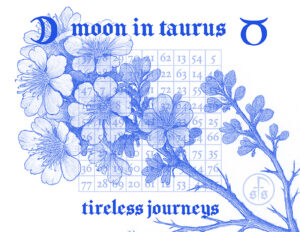
The Moon finds her exaltation in the sign of Taurus, the domicile of Venus. Ptolemy establishes the two planets as natural kin: feminine, nocturnal, and both governed by the same primary quality, moisture. Venus “chiefly humidifies, like the Moon,” he writes, for the same reason the Moon does: she mediates the moist exhalations rising from the earth’s surface and returns them as generative, nourishing force. In ancient and medical astrology, the Moon governs the body, and in Taurus she is sustained by earthy Venusian pleasures. Taurus is the fixed sign of spring: the persistence and deepening of new growth. When the Moon, naturally fluid and changeable, enters a fixed sign, her virtue is given stability and staying power. The quality she transmits in Taurus is enduring. The Moon in Taurus is the Moon in fertile, stable ground.
The Picatrix names the Moon the “mediatrix” of all celestial influence, the one who “received the influences and impressions of all the stars and planets, and pours them down onto the inferior things of this world,” and insists that the practitioner pay attention to her “in all workings, as the foremost of the planets.” It also instructs: “If, under the influence of the Moon, you make the form of a man with the head of a bird holding a staff above him, and holding the image of a branch in bloom in his hand, and do this in the hour of the Moon with the Moon rising in her exaltation, whoever carries this image on a journey will not be tired no matter where they go.”
Travel is one of the Moon’s most consistent significations across the astrological tradition, and the specific promise of this image is inexhaustibility, the removal of depletion. This extends naturally beyond physical journeys to any sustained traversal that demands consistent expenditure of vital force: creative labor, spiritual practice, emotional endurance, the long work of any kind that wears a person down through accumulated attrition. Interestingly, the talismans themselves actually greatly assisted in their own creation in this regard.
The election of these talismans took place on November 4, 2025. At the beginning of the electional window, the Moon was rising on the ascendant in the hour of the Moon, in her degree of exaltation at 2 degrees Taurus (the 3rd degree) and conjoined the ascendant at 3 degrees Taurus. The Moon was waxing and fast in motion. The ruler of the Moon and Ascendant, Venus, was dignified by rulership in Libra and applied to a conjunction with the Part of Fortune. Both the Moon and Venus were free of aspects to the malefics. The chart is available to view in the gallery.
The design of these rings takes the form of a branch in bloom, after the image, and was hand-sculpted in wax and cast in solid sterling silver. During the electional window, white moonstones were engraved with the full talismanic image and suffumigated with camphor and frankincense, both given as appropriate fumigations for the Moon by Agrippa. Moonstone, named for its signature adularescent glow, has been associated with the Moon across traditions since antiquity, its inner light seen as a reflection of lunar virtue. The stones were then later set into the rings above jasmine and mugwort gathered on St. John’s Eve, the time of its greatest magical potency according to folklore. They were ritually enspirited for tireless journeys, in all of their forms. Jasmine was chosen for its lunar nature: white-flowered, intoxicatingly sweet, opening its scent at night. Mugwort shares multiple planetary associations but was chosen for its connection to the lunar goddess Artemis, and also for its connection to the talisman’s intent. Dioscorides writes: “if anyone has the herb artemisia with him while travelling it dissolves weariness.”
Each ring comes with a copy of the devotional artwork above. 11 were made.
May the daimon of these talismans grant you tireless journeys.
References
- Ptolemy, Tetrabiblos
- Picatrix
- Agrippa, Three Books of Occult Philosophy
- Dioscorides, De Materia Medica