


Lovely Hekate of the roads
and of the crossroads I invoke.
In heaven, on earth,
then in the sea, saffron-cloaked,
tomb spirit reveling
in the souls of the dead,
daughter of Perses, haunting deserted places,
delighting in deer,
nocturnal, dog-loving,
monstrous queen,
devouring wild beasts,
ungirt and repulsive.
Herder of bulls,
queen and mistress of the whole world,
leader, nymph,
mountain-roaming nurturer of youths,
maiden, I beseech you to come
to these holy rites,
ever with joyous heart,
ever favoring the oxherd.
The Orphic Hymn to Hekate, Tr. Apostolos N. Athanassakis.
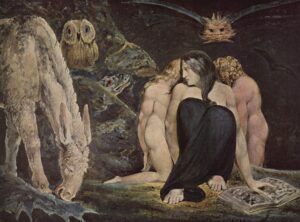
Hekate is one of the most enduring and complex figures of ancient religion and magic. Described in Hesiod’s Theogony as honored above all by Zeus, she holds power over earth, sea, and sky. Over time, her worship came to center especially on thresholds: doorways, boundaries, and crossroads. She was invoked at moments of transition, both physical and spiritual, and became a guardian of liminal spaces, spirits of the dead, and those who walk between. In the Chaldean Oracles, her role expands to a cosmic scale. There she is portrayed as the membrane between the divine and material worlds, the source of the World Soul, and the fountain through which divine fire enters the created realm. Though always chthonic, her identity deepened in late antiquity, and she became increasingly associated with necromancy, graveyard rites, and witchcraft. This evolving reputation did not replace her earlier roles but amplified them, casting her not only as a guide, but as a keeper of thresholds no soul crosses unchanged.
This charm was created as a ritual and devotional object in her honor. The design takes the form of a flaming torch, one of her oldest and most consistent symbols. In the Homeric Hymn to Demeter, Hekate is described as carrying twin torches through the night, the only deity who hears Persephone’s cry from the underworld. In classical art, she frequently appears bearing torches to light the way through darkness. Here, the torch is inverted to emphasize her chthonic aspect, drawing from funerary iconography where the downward flame signifies death and the soul’s descent beneath the earth.
Each piece is set with grey moonstone, historically known as hecatolite. The name derives from Hekate herself. Moonstone has long been associated with lunar goddesses and transitional states. The grey variety was chosen for its connection to liminality. The stone is held in place by three serpentine prongs, referencing the triple crossroads and her three-formed aspect.
The stones were ritually buried at a three-way crossroads on the dark moon and left in place for a full lunar cycle. The three-way crossroads is one of Hekate’s primary ritual sites, and the dark moon was the traditional time of her monthly rites, including the deipnon. When the stones were unearthed, offerings of raw egg and honey were placed into the earth. Both foods are historically associated with Hekate in ancient sources and continued devotional practice. The stones then rested on her altar for two additional lunar cycles before being set into their final form.
Beneath each stone lies powdered yew, a tree traditionally associated with death, regeneration, and the underworld. Yew groves were planted in cemeteries, and the tree was said to regenerate itself from its own decaying core. In some magical texts, slips of yew are included in Hekate’s cauldron. It is both poisonous and evergreen, embodying the transformation between life and death, a central aspect of Hekate’s power as a chthonic goddess.
Each piece was hand sculpted in wax and cast into solid sterling silver. The charm measures approximately 2” tall and comes on your choice of black satin cord or oxidized sterling silver chain.
Only 9 are available.
Further reading:
Theogony by Hesiod
Homeric Hymn to Demeter
The Greek Magical Papyri (PGM)
The Goddess Hekate by Stephen Ronan
Hekate: Liminal Rites by Sorita d’Este and David Rankine
The Hekatæon by Jack Grayle