


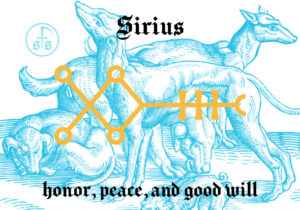
Sirius is the brightest fixed star in the night sky and the lucida of Canis Major, the Greater Dog. Its Greek name Seirios means “sparkling” or “scorching,” and Richard Hinckley Allen in Star Names: Their Lore and Meaning traces it to a common ancient root shared by the Egyptian, Persian, Phoenician, and Roman equivalents, possibly deriving from the Sanskrit Sūrya, “the Shining One.” Among the Babylonians it was Kak-shidi, “Creator of Prosperity.” The Arabic name Al Shi’ra al ʽAbur, “the Bright Star of Passage,” refers to a legend in which the stronger of two sister stars crossed the Milky Way; she succeeded and became “the Shi’ra Who Crossed Over,” while her weaker sister remained weeping on the northern bank. Sirius is the only star named explicitly in the Quran (53:49).
The star’s heliacal rising was the foundational calendrical event of ancient Egypt. At the latitude of Memphis and Thebes, its first dawn appearance after approximately seventy days of invisibility coincided with the annual inundation of the Nile, marking the Egyptian New Year and the season of Akhet. Allen states that Sirius was “the only star known to us with absolute certitude in the Egyptian records,” its hieroglyph appearing throughout the monuments and temple walls of the Nile country. The astronomer Norman Lockyer, who pioneered the study of ancient temple alignments, identified seven temples oriented to its rising, including the great temple of Hatshepsut at Deir el-Bahari and the small temple of Isis at Denderah. The seventy days of the star’s invisibility matched the prescribed duration of the Egyptian mummification process.
The Egyptian goddess Sopdet, Hellenized as Sothis, is the divine personification of Sirius. As early as the First Dynasty she was known as “the bringer of the New Year and the Nile flood.” In the Pyramid Texts she prepares yearly sustenance for the pharaoh and serves as a guide in the afterlife, showing the deceased “goodly roads” in the Field of Reeds. By the Ptolemaic period she had merged almost completely with Isis; in the Lamentations of Isis and Nephthys, Isis calls herself Sopdet. The Greco-Roman syncretic form Isis-Sothis depicted the goddess riding side-saddle on a large dog. Allen notes that “for a long time in Egypt’s mythology” Sirius was “the resting-place of the soul of that goddess, and thus a favorable star.” The Greco-Egyptian conflation Sopdet-Anubis linked the star to the jackal-headed guide of the dead through their shared canine iconography.
In Greek tradition the constellation Canis Major was most prominently identified with Laelaps, the hound destined always to catch its prey, placed among the stars by Zeus after an unanswerable paradox, and with Maera, the faithful hound of Icarius of Athens, who led his daughter to his murdered body and was placed in the sky alongside him. Sirius was above all the Dog of Orion, the hunter’s companion, and Homer in the Iliad calls it the star that comes forth at harvest-time, “brightest of all.”
According to Ptolemy in the Tetrabiblos, Sirius is of the nature of Jupiter and Mars. Vivian Robson in The Fixed Stars and Constellations in Astrology states: “It gives honor, renown, wealth, ardor, faithfulness, devotion, passion and resentment, and makes its natives custodians, curators and guardians.” Bernadette Brady in Brady’s Book of Fixed Starsholds that Sirius carries the quality of the individual whose small action has a large effect on the collective, and that “the mundane may become sacred.” Elsbeth Ebertin in Fixed Stars and Their Interpretation calls it a star that “from time immemorial was the ‘Royal one'” and affirms that “well-connected, it promises fame, honors and riches.”
Sirius is the fifth of the fifteen Behenian fixed stars. According to Hermes on the 15 Fixed Stars, one part savine juniper juice with wormwood and bistort and a little serpent’s tongue put under beryl “grants the favor of the spirits of the air and the peoples of the earth, and brings peace and concord between kings and other potentates, and between husbands and wives.” Agrippa in Three Books of Occult Philosophy writes: “Under the greater Dog-star, they made the image of an Hound and a little Virgin; it bestoweth honor and good will, and the favor of men, and Aerial spirits, and giveth power to pacifie and reconcile Kings, Princes, and other men.” Agrippa also lists the stone as beryl, the herbs as savin, mugwort, and dragonwort.
Albertus Magnus in De Mineralibus writes that beryl “is said to be effective against peril from enemies and against disputes, and to give victory. It is also said to cause mildness of manner and to confer cleverness.” Hildegard of Bingen writes in the Physica that “Whoever keeps a piece of beryl constantly about them, and frequently takes it in their hand and frequently focuses on it, will not easily argue with other people, nor will they be quarrelsome, but they will remain calm.” This calming, conciliatory quality aligns directly with the talisman’s purpose. Medieval and Renaissance scryers preferred polished beryl spheres; George Kunz wrote that “beryl produced a greater number of visions than any other mineral.” The German word Brille (spectacles) derives from Middle High German berille, “beryl,” because the first spectacle lenses were ground from colorless beryl.
Culpeper assigns wormwood to Mars: “an herb of Mars” sovereign against the stings of martial creatures. Savin, is a species of Juniper, which has one of the most universal traditions of purification and apotropaic power across Western and Central Eurasian practice: used in Egyptian kyphi incense and embalming, burned by the Greeks to ward off evil spirits at funerals, and associated in the Greek Magical Papyri with Hekate.
These talismans were designed in the shape of a hound after the talismanic image. I was doing research at the time into ancient Celtic artifacts as part of some ancestral work and so the style of these talismans was loosely inspired by Celtic knotwork. During the electional window beryl stones were engraved with the sigil of Sirius and suffumigated and enspirited to grant, honor, peace, and the favor of spirits and men. The election took place on August 19 2025, and these talismans received dual empowerment as the election took place on the date of the Sirius’ heliacal rise for my location. At the time of the election, Sirius culminated on the midheaven with the Moon applying to conjoin. The Moon was free of applying hard aspects to malefics and applied to the benefic Jupiter in his sign of exaltation, which also culminated on the midheaven. The Lord of the moon was the Moon herself and was dignified by rulership and fast in motion. The ruler of the ascendant Venus was dignified by term and triplicity and co-present with Jupiter and Sirius in the 10th. The 2 drawbacks of this election was that the Moon was waning and also separating from a square with Mars, however I found these acceptable as the aspect was separating and Mars is weakened in the 12th. Additionally the presence of an benefic on the midheaven overcomes issues with the Moon. The chart is available to view in the product gallery.
Each talisman measures approximately 2.3 inches tall and comes on a black satin cord or oxidized sterling silver chain, along with a copy of the devotional artwork above printed on card stock. Only 10 are available.
May the daimon of these talismans grant you honor, peace, and the favor of spirits and men.
References
- Ptolemy, Tetrabiblos
- Agrippa, Cornelius. Three Books of Occult Philosophy
- Hermes on the 15 Fixed Stars
- Allen, Richard Hinckley. Star Names: Their Lore and Meaning
- Robson, Vivian. Fixed Stars and Constellations in Astrology
- Brady, Bernadette. Brady’s Book of Fixed Stars
- Ebertin, Elsbeth. Fixed Stars and Their Interpretation
- Albertus Magnus. De Mineralibus
- Hildegard of Bingen. Physica
- Culpeper, Nicholas. The Complete Herbal