


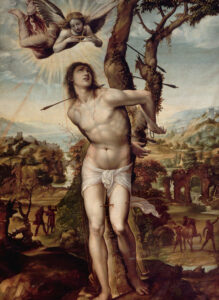
Saint Sebastian served as a captain in the Praetorian Guard under the emperors Diocletian and Maximian, using his position to secretly minister to imprisoned Christians. When his faith was discovered, Diocletian ordered him bound to a stake and shot through with arrows. The widow Irene came to recover his body and found him alive. She nursed him back to health, and when he had recovered, Sebastian returned to Diocletian and denounced him to his face. The emperor had him beaten to death with clubs and his body thrown into the Cloaca Maxima, the great sewer of Rome, to prevent his veneration. Some writers have suggested that Sebastian was rumored to be Diocletian’s lover, lending a jealous subtext to the martyrdom. The Acta Sanctorum notes that Sebastian was “dearly beloved of the Emperors Diocletian and Maximian,” and the legend describes Sebastian’s discovery as a betrayal. His second confrontation with Diocletian underscores this: having survived the execution, he returned to the emperor’s door.
Jacobus de Voragine’s Golden Legend transmits the legend of Sebastian as plague saint: a devastating pestilence among the Lombards ceased only after the erection of an altar to him in Pavia around 680 CE. The association between arrows and pestilence runs from Apollo’s plague-arrows in the Iliad forward through medieval iconography, and Sebastian, a man who survived being shot through with arrows, offered a counterimage: a body pierced but not destroyed. The earliest surviving depiction of him, a sixth-century mosaic in Sant’Apollinare Nuovo in Ravenna, shows a mature, bearded figure in court dress with no trace of an arrow. He remained a soldier-saint in the Byzantine manner for roughly a thousand years.
In the Renaissance his image changed entirely. As painters sought to depict the idealized male nude, Sebastian was one of the very few religious subjects whose partial nakedness was theologically justified, and the classical revival found in his bound body a vessel for ancient sculptural forms. Mantegna painted him three times. Botticelli’s version was installed on a pillar in Santa Maria Maggiore on January 20, 1474, with ceremony. Perugino’s Louvre panel takes its contrapposto directly from the Doryphoros of Polykleitos. Vasari records that Fra Bartolommeo’s nude Sebastian had to be removed from its church after women confessed to impure thoughts before it. Guido Reni painted him seven times and established the image that endures: wrists tied above the head, face tilted toward the shoulder, eyes lifted, mouth slightly open, the body idealized and smooth. The Palazzo Rosso in Genoa, which holds one of the finest versions, describes it as “the idealised body of a young man whose beauty is decidedly tinged with sensuality.” Reni took the pose directly from the Belvedere Torso, the headless Hellenistic marble in the Vatican.
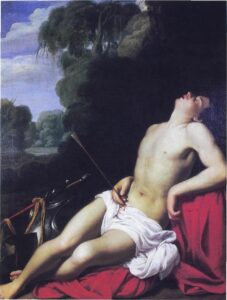
Oscar Wilde encountered Reni’s Sebastian at the Palazzo Rosso during Holy Week 1877 and wrote of “a lovely brown boy, with crisp, clustering hair and red lips, bound by his evil enemies to a tree, and though pierced by arrows, raising his eyes with divine, impassioned gaze towards the Eternal Beauty of the opening heavens.” After his conviction and imprisonment, Wilde crossed to France under the name Sebastian Melmoth and lived out the remaining three years of his life there. Yukio Mishima described his narrator’s first orgasm occurring before a reproduction of Reni’s painting in Confessions of a Mask (1949), dwelling on the body’s “flames of supreme agony and ecstasy,” and in 1961 posed for photographer Eikoh Hosoe as Sebastian for the photobook Barakei. Derek Jarman’s Sebastiane (1976), filmed entirely in Latin, depicted Sebastian’s desire and martyrdom without apology. When the AIDS epidemic devastated gay communities in the 1980s and 1990s, his ancient plague patronage acquired new significance. David Wojnarowicz made Peter Hujar Dreaming / Yukio Mishima: Saint Sebastian in 1983, placing his dying lover beside the arrow-pierced saint.
In Candomblé and Umbanda, particularly in Rio de Janeiro, Sebastian is syncretized with Oxóssi, the orixá of the hunt and the forest. Both figures are defined by the arrow, Sebastian pierced, Oxóssi as the archer, and both are associated with those imprisoned or in conflict with the law. Rio de Janeiro was founded on January 20, 1565, and named São Sebastião do Rio de Janeiro; his three arrows appear on the city’s coat of arms. Every January 20, Catholic processions carry his statue through the streets while Candomblé and Umbanda terreiros simultaneously honor Oxóssi.
This pendant was hand-sculpted entirely on his feast day, January 20, working through the full day as a devotional act, and then cast into solid silver and bronze. I used the sculpture The Torso of a Dancing Faun, a first-century CE Roman work, as my way of honoring his legacy as a patron of gay men, artists, and the LBGTQ+ community, and also drawing from the same sculptural tradition as Reni. It measures approximately 2″ tall and comes on a black satin cord or a oxidized sterling silver chain.
References
- Wikipedia, Saint Sebastian
- Ambrose of Milan, Expositio in Psalmum CXVIII
- Jacobus de Voragine, The Golden Legend
- Judika Illes, Encyclopedia of Mystics, Saints, and Sages
- Richard A. Kaye, “Losing His Religion: Saint Sebastian as Contemporary Gay Martyr,” in Outlooks, ed. Peter Horne and Reina Lewis (Routledge, 1996)
- Yukio Mishima, Confessions of a Mask, trans. Meredith Weatherby (New Directions, 1958)