
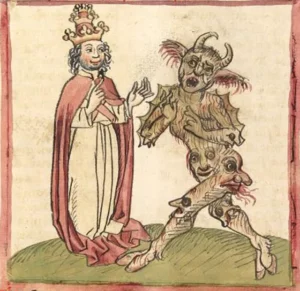
Gerbert of Aurillac, a French scholar of humble origins who became Pope Sylvester II in 999, attracted accusations of sorcery within decades of his death and came to be known as “the sorcerer pope.” Legend held that after being rejected by an earthly love, he entered into a pact with a female demon named Meridiana, who helped him ascend to the papal throne. He was also reputed to have cast a brazen head by astrological election, a head of brass or bronze that would answer questions only in the affirmative or the negative. It was Meridiana, or the head, depending on the telling, who warned him that if he ever said Mass in Jerusalem, the Devil would come for him. He cancelled a pilgrimage to the holy city and thought himself safe, but died shortly after singing Mass at Santa Croce in Gerusalemme in Rome, having not accounted for the Roman church of that name.
The idea of a severed head that speaks prophecy runs through many traditions, from Odin consulting the head of Mimir in Norse myth to John the Baptist’s head, which Orthodox tradition holds continued to speak after death. John Gower attached the same story to Robert Grosseteste in the Confessio Amantis around 1390, and the legend of Roger Bacon’s brass head, which speaks the cryptic phrases “Time is,” “Time was,” and “Time is past” before shattering while its maker sleeps, became one of the most lasting versions of the tale through Robert Greene’s play Friar Bacon and Friar Bungay and an earlier prose romance.
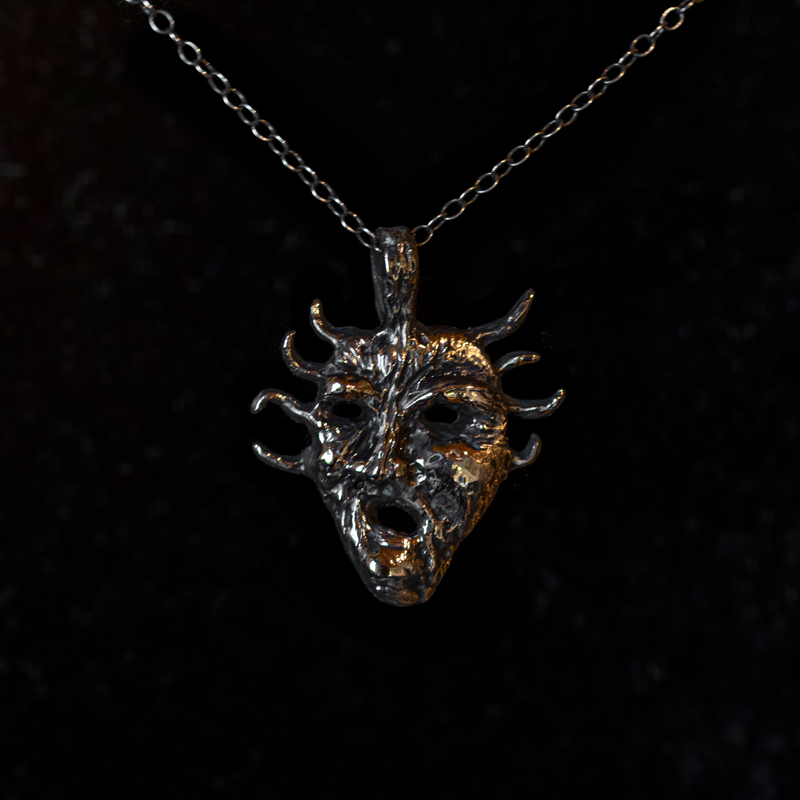
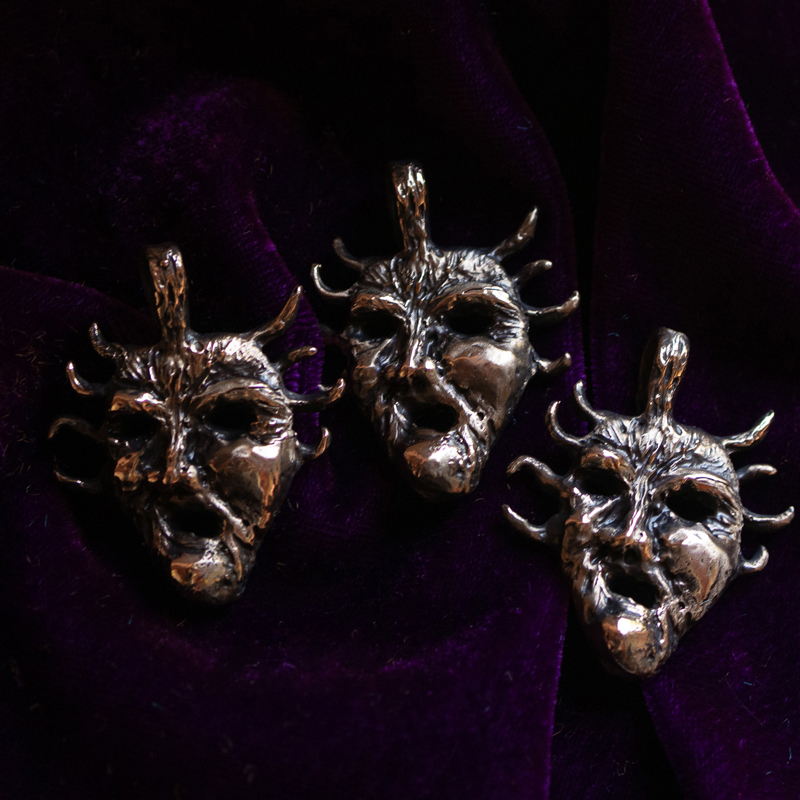
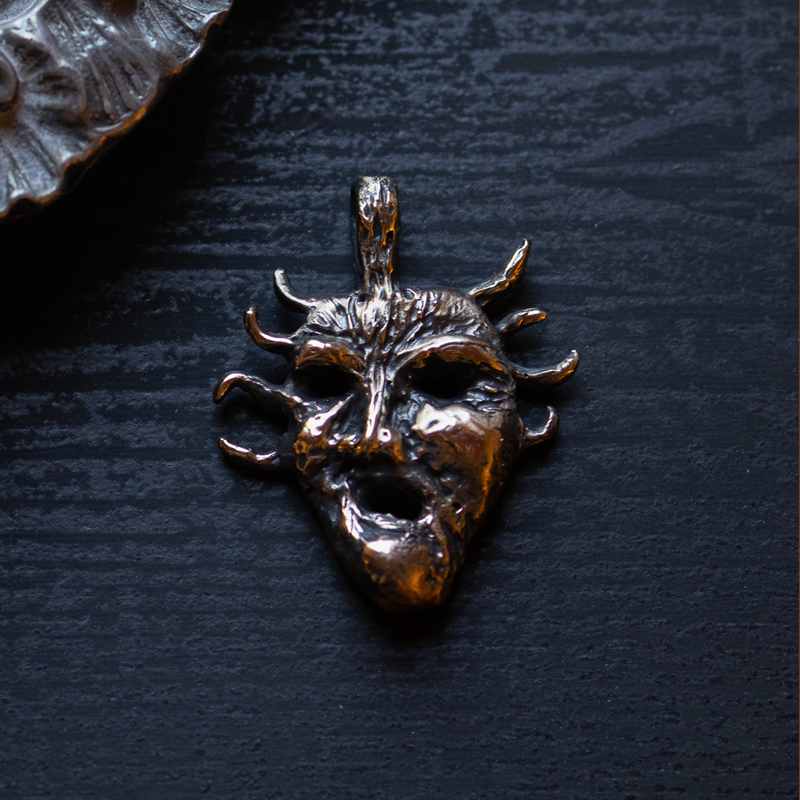
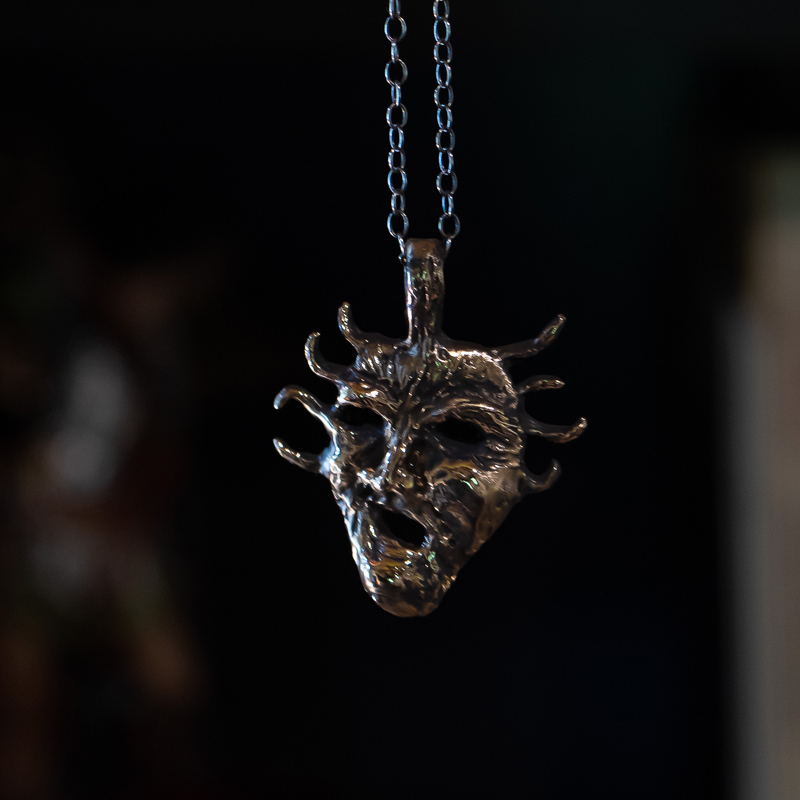
The Brazen Head was sculpted entirely on New Year’s Eve, the feast of Pope Sylvester I, whose burial in 335 fixed his feast day to the final night of the year. I was inspired by the folkloric traditions surrounding this night and its connection to witches and found it curious and interesting that Sylvester II, with his diabolical associations, should take Sylvester I as his namesake. In German-speaking countries and much of Central and Eastern Europe, New Year’s Eve is still called Silvester, named for this feast, and the night carried centuries of folk associations with divination, spirit movement, and the passage of witches through the winter sky and through windows. The completed wax was then tested for use as a pendulum and it responded immediately and quite strongly. It was then left overnight on the windowsill before being cast into solid bronze. These pendants can be worn or used as a pendulum to answer yes/no questions, just like the original head of legend. Each charm measures approximately 1.5″ tall and comes on a black satin cord or oxidized sterling silver chain. Only 8 were made.
References
- William of Malmesbury, Chronicle of the Kings of England, trans. J. A. Giles, 1847
- Robert Greene, The Honorable Historie of Frier Bacon, and Frier Bungay, 1594
- John Gower, Confessio Amantis, c. 1390
- “Brazen Head,” Wikipedia
- “Pope Sylvester I,” Wikipedia
- “Pope Sylvester II,” Wikipedia
- “Saint Sylvester’s Day,” Wikipedia
- Icy Sedgwick, “The Brazen Head: Medieval Prophecy Machine or Tall Tale?”