


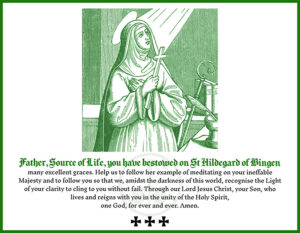
Hildegard of Bingen was born in 1098 in Bermersheim, Germany, the tenth child of a noble family. At the age of eight, she was offered to the Church and placed in the care of Jutta von Sponheim at the Benedictine monastery of Disibodenberg. She took the Benedictine veil at fifteen and was elected abbess in 1136 after Jutta’s death. Hildegard later founded her own monasteries at Rupertsberg in 1150 and Eibingen in 1165. She was a mystic, composer, theologian, herbalist, and medical writer, known as the Sibyl of the Rhine. She experienced visions from the age of three and was commanded by God at forty-two to write them down. Her major works include Scivias, Liber Vitae Meritorum, and Liber Divinorum Operum. She corresponded with popes, emperors, and saints, preaching throughout the Rhineland and challenging both ecclesiastical and political authorities. Hildegard died on September 17, 1179. She was canonized in 2012 by Pope Benedict XVI through equivalent canonization and declared a Doctor of the Church, one of only four women to hold this title. Her feast day is September 17.
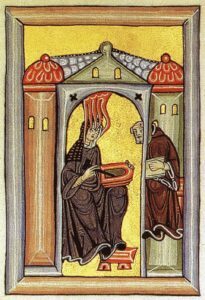 In 1141, at the age of forty-two, Hildegard received the vision that would compel her to begin writing. She describes it in Scivias: “A fiery light, of the greatest flashing brightness, coming out of a cloudless sky, flooded my entire mind and so inflamed my whole heart and my whole breast like a flame, yet it was not blazing but glowing hot, as the sun makes anything on which its rays fall hot.” In her Declaration, she writes, “I saw a great splendor in which resounded a voice from Heaven, saying to me, ‘O fragile human, ashes of ashes, and filth of filth! Say and write what you see and hear.'” The illuminated manuscripts of Scivias depict this moment with tongues of fire descending from heaven into her mind as she writes. She describes these flames: “Like a flame that does not burn but enkindles, it inflamed my entire heart and my entire breast, just like the sun that warms an object with its rays.”
Viriditas is one of Hildegard’s most significant theological contributions. The Latin word literally means “greenness” but encompasses vitality, fecundity, verdure, and growth. For Hildegard, viriditas was the greening power of God, the creative force inherent in all life. In Liber Divinorum Operum, she writes, “I, the fiery life of divine essence, am aflame beyond the beauty of the meadows, I gleam in the waters, and I burn in the sun, moon, and stars. With every breeze, as with invisible life that contains everything, I awaken everything to life.” Hildegard saw this greening as both a physical and spiritual force, present in plants, humans, and all creation. She contrasted viriditas with ariditas, dryness or spiritual death. A dried-up person or culture loses the ability to create, which she saw as a grave sin. Viriditas was moisture, fruitfulness, vigor of the soul, signs of being alive and engaging with the living force of the creator. She saw it as the Holy Spirit, a green sap flowing through all things, the capacity for juiciness, greenness, and moistness within creation. For Hildegard, the greening power was evidence of divine healing, visible in gardens, forests, and the creative works of humans aligned with God’s will.
These devotional charms were created as part of a group event in honor of Saint Hildegard organized by my friend Dr. Finch of Dr. Finch Conjure. The design was inspired by the vision of tongues of flame descending from heaven with the plants growing from her mouth to represent viriditas. These were hand-sculpted in wax on the days leading up to her feast and then cast in solid sterling silver.
Each charm measures approximately 1.75 inches tall and comes on your choice of black satin cord or oxidized sterling silver chain, along with a copy of the devotional prayer card pictured above printed on card stock.
References
- Godfrey of Disibodenberg and Theodoric of Echternach. Vita Sanctae Hildegardis (Life of Saint Hildegard).
- Hildegard of Bingen. Liber Divinorum Operum (Book of Divine Works).
- Hildegard of Bingen. Scivias (Know the Ways). 1141-1151.