
Many a night I saw the Pleiads, rising thro’ the mellow shade,
Glitter like a swarm of fire-flies tangled in a silver braid.
— Alfred, Lord Tennyson, Locksley Hall
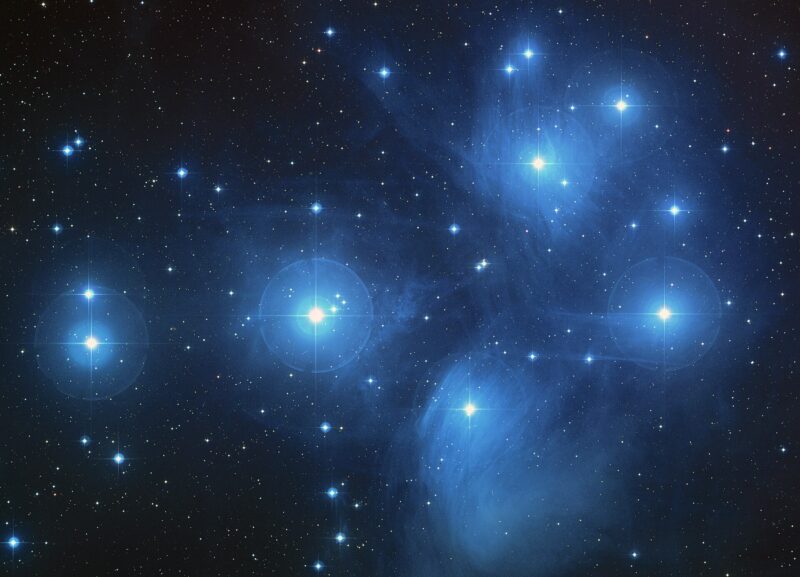
The Pleiades, catalogued as Messier 45 and also known as the Seven Sisters, form one of the nearest and most optically prominent open star clusters visible from Earth, located approximately 444 light years away. The cluster lies in the northwest of the constellation Taurus the Bull and contains over a thousand gravitationally bound stars, but most observers can see only six with the unaided eye, and under excellent dark-sky conditions perhaps nine to fourteen. The stars are young by galactic standards, approximately 100 million years old, and hot: the brightest members are blue-white B-type giants whose light is scattered by a surrounding veil of interstellar dust. The cluster spans about two degrees on the sky, roughly four times the apparent diameter of the full moon, and at an apparent magnitude of 1.6 it is visible even from light-polluted cities. In antiquity, counting how many of the seven stars one could see served as a practical test of visual acuity.
Alcyone (η Tauri), the brightest star in the Pleiades at apparent magnitude +2.87, is a blue-white giant of spectral type B7IIIe, roughly 1,750 times more luminous than the Sun and spinning so rapidly that it has thrown off a circumstellar disk of gas. Because all the major Pleiades stars lie within about one degree of one another along the ecliptic, Alcyone has long served as the single representative of the whole cluster in astrological tradition.
In ancient and classical calendars the Pleiades functioned as a primary seasonal timer through their heliacal rising (first pre-dawn visibility after a period of invisibility in the Sun’s rays) and their acronychal or cosmical setting (their setting at sunset). Homer placed them first among the constellations wrought on the Shield of Achilles and made them the navigational stars by which Odysseus steered his raft across open water on Calypso’s instructions. Hesiod’s Works and Days gives the instructions: “When the Pleiades, daughters of Atlas, are rising, begin your harvest, and your ploughing when they are going to set. Forty nights and days they are hidden and appear again as the year moves round, when first you sharpen your sickle.” Hesiod also uses them as a marker for sailing: “But if desire for uncomfortable sea-faring seize you; when the Pleiades plunge into the misty sea to escape Orion’s rude strength, then truly gales of all kinds rage. Then keep ships no longer on the sparkling sea.” Because of the precession of the equinoxes, the calendrical dates of these phenomena have shifted substantially. Around 2300 BCE the Pleiades stood at or near the vernal equinox. By the time of Hesiod (c. 700 BCE), the heliacal rising of the Pleiades at the latitude of Greece fell in early May and the cosmical setting around early November. Bernadette Brady, drawing on Allen and later ethnoastronomers, emphasises that the acronychal rising of the Pleiades in November in the northern hemisphere corresponds cross-culturally to festivals of the dead. Allen, citing Agnes Clerke’s System of the Stars (1890), links the November midnight culmination to a range of ancient observances across Persia, Egypt, and Mesoamerica, though these specific equations are unverified in modern scholarship.
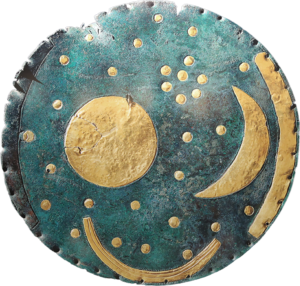
The Nebra Sky Disk, a bronze disk approximately 30 cm in diameter inlaid with gold symbols, was unearthed in 1999 on the Mittelberg near Nebra in Saxony-Anhalt, Germany. It has been dated archaeologically and by radiocarbon analysis of associated material to approximately 1800 to 1600 BCE, making it the oldest known concrete depiction of the cosmos from anywhere in the world. The disk shows the Sun or full Moon, a lunar crescent, and thirty-two stars, including a compact cluster of seven stars standardly interpreted as the Pleiades; the two lateral gold arcs are understood as horizon markers registering the angles of solstitial sunrise and sunset at the latitude of the find site. In the Hall of the Bulls at Lascaux Cave in the Dordogne, a group of six painted dots floats above the shoulder of a large aurochs (Bull No. 18), and a V-shaped arrangement of dots appears on the animal’s face. The German archaeoastronomer Michael Rappenglück, in a 1997 paper, argued that these dots represent the Pleiades and the Hyades respectively, with the bull’s eye standing for Aldebaran, making the entire composition a Magdalenian-era precursor of the constellation Taurus. Frank Edge independently proposed the same identification the same year. The interpretation remains debated, however, and is not accepted by mainstream Palaeolithic art specialists.
The seven sisters of Greek myth are the Pleiades, daughters of the Titan Atlas and the Oceanid Pleione. Hesiod’s Astronomy preserves their names in a fragment: “Lovely Teygata, and dark-faced Elektra, and Alkyone, and bright Asterope, and Kelaino, and Maia, and Merope, whom glorious Atlas begot.” Pseudo-Apollodorus records that they were born on Mount Cyllene in Arcadia and names them: Maia, Electra, Taygete, Alcyone, Celaeno, Sterope, and Merope.
Six of the seven became consorts of gods. Maia, the eldest, bore Hermes to Zeus. Electra bore Dardanus, founder of the Trojan royal line. Alcyone lay with Poseidon and bore Hyrieus. Only Merope, the youngest, married a mortal: Sisyphus, king of Corinth, and her shame became the traditional explanation for why only six stars are clearly visible. Aratus states: “Seven are they in the songs of men, albeit only six are visible to the eyes. Yet not a star, I ween, has perished from the sky unmarked since the earliest memory of man.” Ovid, in the Fasti, writes that “the seventh, Merope, was married to a mortal man, to Sisyphus, and she repents of it, and from shame at the deed she alone of the sisters hides herself.” Hyginus adds that “because she married a mortal, her star is dim.” An alternative reading holds that Electra is the lost sister: after the fall of Troy and the destruction of the dynasty she had founded through Dardanus, she left the Pleiades’ circle and withdrew into the Arctic sky, her hair unbound in grief. Quintus Smyrnaeus, in his Fall of Troy, writes that Electra “shrouded her form in mist and cloud, and left the Pleiad-band, her sisters.”
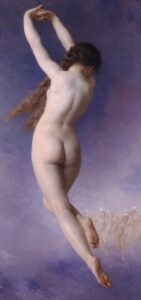
Pseudo-Hyginus recounts their transformation into stars in Astronomica. While Pleione was traveling through Boeotia with her daughters, the giant hunter Orion tried to seize her. He pursued them for seven years and could not find them. Zeus, pitying the sisters, “appointed a way to the stars,” and “so up to this time Orion seems to be following them as they flee towards the west.” Some versions of the story include an intermediate transformation into doves (peleiades), a folk etymology that links the sisters’ name to the Greek word for dove.
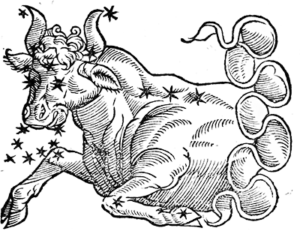
In Babylonian and Sumerian astronomy the cluster is named MUL.MUL (𒀯𒀯), literally “star of stars.” In the Akkadian tradition it is also Zappu, “the Bristle” or “tuft of hair,” linking the Pleiades to the shoulder-tuft of the Bull of Heaven (Taurus). The cluster was later associated with the Sebettu or Sibitti, “the Seven,” a group of warrior-gods linked to Erra/Nergal, and accumulated an omen tradition of war, death, disease, and disorder in Mesopotamian celestial divination. The Babylonian calendar used the heliacal rising of MUL.MUL in the month of Ayāru as a marker for intercalation decisions, giving the cluster a regulatory function over the religious and administrative calendar.
In the Vedic tradition the Pleiades are the nakshatra Kṛttikā, “the Cutters,” associated with a sharp implement, and ruled by Agni, the god of fire. The six Kṛttikā sisters incubated the seed of Śiva, from which six babies were born; Parvati embraced them and they became one person with six heads, Kartikeya, the warrior god whose birth was the only means of defeating the demon Taraka.
In the Chinese system of twenty-eight lunar mansions the Pleiades constitute Mao (昴), the “Hairy Head,” generally inauspicious: its flickering was read as a portent of barbarian invasion, and the mansion presided over judicial hearings, punishments, and death in the family.
The Hebrew Bible names the Pleiades as Kimah (כִּימָה) in three passages: Job 9:9, Job 38:31, and Amos 5:8. Job 38:31 — “Can you bind the cluster of the Pleiades, or loose the cords of Orion?” — treats the cluster as an emblem of divine order inaccessible to human power. The Talmud (Berakhot 58b) records Shmuel teaching that without the heat of Kesil (Orion) the world could not endure the cold of Kimah, and without the cold of Kimah it could not endure the heat of Kesil. One tradition connects the cluster with the waters of the Flood, the two stars removed from Kimah having been the source of the inundation.
Slavic folklore preserves some of the most vivid Pleiades lore in the European tradition. The principal Belarusian name for the cluster is Sita, “sieve,” imagining the stars as holes through which light and matter pass. In the Słuck and Homiel regions the Sieve is the place where angels sort the dead: “The Sieve is fiery candles in the sky in the place where righteous souls get together. Angels sift here the righteous souls from the wicked”; “The souls are sifted: the wicked to hell, and the righteous to paradise.” Meteors in this cosmology are souls escaping Purgatory. The Polish-Belarusian poet Adam Mickiewicz recorded a related tradition in 1834: “To the north shines the circle of the starry Sieve, through which God, as they say, gifted grains of corn, when he cast them down from heaven for Adam our father, who had been banished for his sins from paradise.” The cluster’s form as a brood hen with her chicks appears across Western Polesia, and in cognate traditions throughout Western and Northern Europe.
In Mesoamerica the Pleiades are the Aztec Tianquiztli, “the marketplace.” Every 52 years, priests on Mt. Uixachtecatl waited until the Pleiades reached the zenith at midnight to perform the New Fire Ceremony, drilling a new fire on a sacrificial victim’s chest and distributing it to temples and homes throughout the empire to ensure another cycle of cosmic continuity.
In Aotearoa the Māori call the cluster Matariki; its heliacal rising in late June or early July signals the start of the Māori New Year, a time of mourning the year’s dead and forecasting the coming season. In Aboriginal Australia the Seven Sisters songline extends across more than half the continent, functioning simultaneously as an astronomical chart, a legal and ceremonial code, and an ecological handbook, with each section of the narrative tied to specific waterholes, landforms, and seasonal indicators.
In Arabic astronomy the Pleiades are Al-Thurayyā (الثريّا), “the Many Little Ones.” Al-Thurayyā is the third of the twenty-eight Arabic lunar mansions (manāzil al-qamar), currently extending in the tropical zodiac from approximately 25°42′ Aries to 8°34′ Taurus and taking Alcyone as its determinant star. The tenth-century Islamic astrologer Ibn Hatim describes it as “six stars joined together and one other small one.” In the classical Indian and earliest Arabic systems the mansion corresponding to the Pleiades was the first; with the adoption of the tropical zodiac beginning at 0° Aries, the mansion now falls in the third position after Al-Sharatain and Al-Butain. The mansion contains the exaltation degree of the Moon, at the third degree of Taurus.
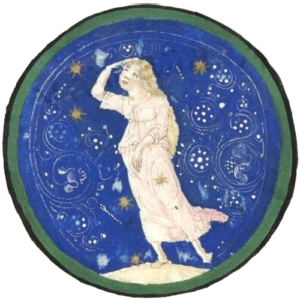
The Picatrix contains the following instructions for the creation of a talisman: “The third Mansion is Azoraye (that is, the Pleiades) and is for the acquisition of all good things. Make the figure of a seated woman with her right hand over her head, and wrap it in cloth, suffumigate it with musk, camphor, mastic and aromatic oils. Say: ‘You, Annuncia, make it so.’ Make the image in a silver ring with a square table, and put it upon your finger and it will be as you wish. Know that Annuncia is the name of the lord of this mansion.” The mansion profits sailors, huntsmen, and alchemists, and is unfavourable for marriage or travel by water. Agrippa transmits the same prescription, giving the spirit’s name as Amnixiel in his Three Books.
Ptolemy’s Tetrabiblos assigns the Pleiades the nature of Moon and Jupiter; Ashmand’s translation from Proclus’s Paraphrase gives Moon and Mars, and the subsequent astrological tradition follows Ashmand. The doctrine that the Pleiades portend blindness and afflictions to the eyes derives from Ptolemy’s treatment of “nebulous stars” in Tetrabiblos 3.12 and runs through the later tradition. Manilius’s Astronomica Book 5 describes the rising Pleiades as producing natives devoted to adornment, feasting, wine, love, and spectacle: “The Pleiades, sisters who vie with each other’s radiance. Beneath their influence devotees of Bacchus and Venus are born into the kindly light, and people whose insouciance runs free at feasts and banquets and who strive to provoke sweet mirth with biting wit.”
Vivian Robson’s The Fixed Stars and Constellations in Astrology writes of the Pleiades: “They are said to make their natives wanton, ambitious, turbulent, optimistic and peaceful; to give many journeys and voyages, success in agriculture and through active intelligence; and to cause blindness, disgrace and a violent death. Their influence is distinctly evil.” Of Alcyone specifically he writes that it causes “love, eminence, blindness from fevers, small-pox, and accidents to the face.”
In Brady’s Book of Fixed Stars Bernadette Brady reinterprets the cluster’s long association with blindness as a signature of inner sight, and in her practice clients with strong Alcyone contacts are consistently driven toward esoteric knowledge. She adds: “In addition to Alcyone’s links to vision, physical or mystical, there is also a strong connection to the Fates and the judgment of the dead, bringing in a ruthlessness when dealing with those who have not fulfilled necessary requirements, a potential for ruthlessness or judgmental anger. In working with this star, then, look past the doves of the Greeks.”
Rosenberg’s Secrets of the Ancient Skies finds that wherever the Pleiades fall, there will be “something to weep about,” connecting the cluster’s eye symbolism not only to sight and blindness but to tears themselves, to grief made visible. Elsbeth Ebertin’s Fixed Stars and Their Interpretation, by contrast, emphasises ambition, preferment, honor, and glory.

The Pleiades hold a place among the fifteen Behenian fixed stars. According to the Book of Hermes on the Fifteen Fixed Stars: “Fennel seed with frankincense and quicksilver placed under a crystal with the appropriate character [engraved on it], with the Moon conjunct the Pleiades rising or at midheaven, preserves the eyesight, summons demons and the spirits of the dead, calls the winds, and reveals secrets and things that are lost.” Agrippa adds the talismanic image: “Under the constellation of Pleiades, they made the image of a little Virgin, or the figure of a Lamp; it is reported to increase the light of the eyes, to assemble spirits, to raise winds, to reveal secret and hidden things.”
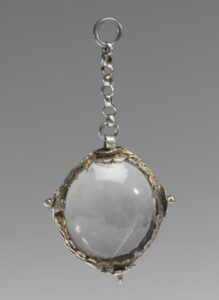
Rock crystal (clear transparent quartz) is the Behenian stone of the Pleiades. The Greek krystallos records the ancient belief that the stone is ice so thoroughly frozen it cannot melt, a stone, as Pliny writes in the Natural History, “similar to ice in color and transparency,” found in greatest abundance in the northern Alps where the sun never shines its hottest rays. Camillo Leonardi’s Speculum Lapidum records that crystal hung over a sleeper dispels bad dreams and frees those who have been charmed; held in the mouth it lessens thirst; ground with honey it fills the breasts with milk. A ball of crystal placed under the sun’s rays ignites any matter placed beneath it. Claude Lecouteux’s A Lapidary of Sacred Stones, a modern synthesis drawing on a wide range of ancient and medieval sources, records that crystal enlivens the soul but fatigues the eyes and disrupts the strength of the nerves, that it procures the favor of the gods and grants prayers, heals the kidneys when attached there, and is cold when taken from fire but will set fire to dry resinous wood. A stone that has lost its virtue must be touched by a crystal, which will then “confess the sin that caused it to lose its power.” The stone’s transparency made it the standard scrying medium in European magical practice from the medieval period onward; John Dee’s Elizabethan workings used a rock crystal globe, now held at the Science Museum in London, for angelic communication. Hildegard of Bingen’s Physica treats crystal as born from cold waters “which are nearly black,” congealed by cold and air into a solid “as if it were the heart of water,” then touched by heat to acquire its whiteness, becoming so pure that heat cannot dissolve it even as ice around it melts. On its medical use she notes: one whose eyes are blurry should heat crystal in the sun and place it often over the eyes, “because it is of a watery nature, it draws bad humors from the eyes, which improves the vision.” For swellings or scrofula on the neck, crystal heated in the sun and tied over the place for a day or night will cause them to vanish. For ailments of the heart, stomach, or belly, crystal heated in the sun and placed in water, then the water drunk frequently, brings relief. The stone’s affinity to the eyes is both physical and magical: transparency, reflection, vision, burning-glass.
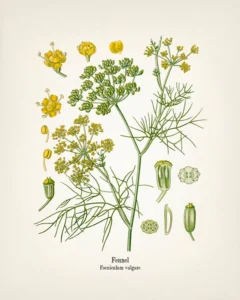
Fennel (Foeniculum vulgare, Apiaceae) is the Behenian herb of the Pleiades. Its use in the preservation and restoration of sight is documented already by Nicander of Colophon in the 2nd century BCE and transmitted through Pliny’s Natural History: “Fennel has been rendered famous by the serpent, which tastes it, as already stated, when it casts its old skin, and sharpens its sight with the juice of this plant: a fact which has led to the conclusion that this juice must be beneficial, also, in a high degree to the human sight.” Dioscorides in the De Materia Medica records that juice from the bruised stalks and leaves, dried in the sun, “is a useful preparation for eye medicines, such as for restoration of the sight,” and that the green seed together with leaves and branches is juiced for the same purposes, as is the root when new stems emerge; he also notes that the herb eaten draws down milk in breastfeeding and that a decoction of the fronds is good for inflamed kidneys and disorders of the bladder. Culpeper’s Complete Herbal (1653) assigns fennel to Mercury under Virgo and notes: “Fennel increases milk, cleanses the eyes from mists that hinder sight and take away the loathings which oftentimes happens to the stomachs of sick and feverish persons.” He adds that the seed boiled in wine is good for those bitten by serpents or who have eaten poisonous herbs, and that it helps open obstructions of the liver, spleen, and gall. Hildegard of Bingen’s Physica describes fennel as having “a mild heat and is of neither a dry nor cold nature,” and notes that eating fennel or its seed daily “diminishes bad phlegm and decaying matter, keeps bad breath in check, and makes one’s eyes see clearly.” For eye complaints she distinguishes by eye color and season: for one with blue-gray eyes suffering dimness and pain she prescribes crushed fennel or its seed mixed with dew from growing grass and fine wheat flour, made into a small cake and tied around the eyes at night; for one whose eyes resemble stormy clouds suffering fogginess she prescribes crushed fennel in summer or crushed seed in well-beaten egg white in winter, placed over the eyes at sleep. For melancholy she prescribes fennel pounded to a liquid and rubbed on the forehead, temples, chest, and stomach. The herb also carries a reputation in medieval European folk magic as a protection against witchcraft and evil spirits when hung over doorways or stuffed into keyholes on Midsummer Eve, documented in Richard Folkard’s Plant Lore, Legends, and Lyrics.
Frankincense, the aromatic resin harvested from trees of the genus Boswellia, is the third materia of the Pleiades talisman. One of the oldest documented trade commodities in the ancient world, it appears in Exodus 30 among the four ingredients God prescribes for the sacred incense of the Tabernacle, alongside stacte, onycha, and galbanum, to be burned perpetually before the Ark of the Covenant. It is one of the three gifts brought by the Magi to the infant Christ in Matthew 2:11, and its ritual use has continued unbroken in Catholic and Orthodox liturgy, where its rising smoke is understood as prayer made visible and as a transformation of profane space into sacred space.
Dioscorides treats frankincense (thus, also thurifera) in Book I of the De Materia Medica among the gums of trees. He describes the best grade as naturally round, white when uncut, fat within when broken, and burning clean and straight when set to flame. He notes that grades are often adulterated with pine resin and gum, and gives a reliable test: “the gum when put into a fire does not flame out, and the resin evaporates into smoke, but the thus is kindled and by its scent proves itself.” On its medical properties he reports: it is warming and astringent, able “to clean away things which darken the pupils, fill up the hollowness of ulcers and draw them to a scar, and to glue together bloody wounds,” and capable of suppressing excessive discharges of blood. Taken as a drink it helps those who spit blood; in large quantity with wine, however, it kills, and taken by those who are healthy it brings madness. He treats the soot of frankincense separately, noting its ability to soothe inflammation of the eyes, repress discharges, clean ulcers, and treat diseases of the cornea.
Pliny devotes three chapters of Natural History Book XII to frankincense, describing its origin, the trees, and the varieties of resin. He insists that no country besides Arabia produces it, and that even within Arabia it belongs to fewer than three thousand families among the Sabaeans, held as hereditary property, the collectors being called sacred and “not allowed, while pruning the trees or gathering the harvest, to receive any pollution, either by intercourse with women, or coming in contact with the dead.” He records Alexander the Great as a boy heaping the altars with frankincense, and his tutor Leonides remarking that it would be time to worship the gods without limit only when he had conquered the frankincense-producing countries; when Alexander did conquer Arabia, he sent Leonides a shipload of the resin.
Hildegard of Bingen in the Physica describes frankincense as “more hot than cold,” with an odor that “ascends even without fire.” She prescribes it pulverized with fine wheat flour and egg white, made into little cakes and dried in the sun, then held near the nostrils: “Their odor will strengthen you, clear your eyes, and fill your brain.” For headache she recommends the same cakes tied to the temples at night. For quotidian fevers she prescribes frankincense pounded with spearmint and placed over the navel.
In the grimoire tradition frankincense appears as a general consecrating agent, present in the suffumigation prescriptions of the grimoires including the Grimorium Verum. Agrippa in Three Books of Occult Philosophy gives the general rule that all gums are solar in nature, placing frankincense at the head of solar suffumigations and describing its use across invocation, consecration, and the fumigation of talismans.
Quicksilver (argentum vivum; Greek hydrargyros) is the final materia of the Pleiades talisman. Pliny describes it in Natural History Book XXXIII as a mineral found in the veins of silver, yielding “a humour that is always liquid.” He records its fundamental physical properties with precision: “It acts as a poison upon everything, and pierces vessels even, making its way through them by the agency of its malignant properties. All substances float upon the surface of quicksilver, with the exception of gold, this being the only substance that it attracts to itself.” This affinity for gold makes it an excellent refiner: shaken briskly in an earthen vessel with gold, it rejects all impurities, and the gold is then separated by pouring the mixture onto well-tawed skins through which the quicksilver exudes “like a sort of perspiration,” leaving the gold behind in purity. In gilding, a coat of quicksilver laid beneath gold leaf retains it “with the greatest tenacity.”
Dioscorides treats quicksilver (hydrargyrum) in Book V among the metallic stones, where he gives both its natural and artificial sources. It is found naturally in the mines, gathered in drops on the roofs of silver smelting works. The artificial preparation begins with ammion, which he identifies as cinnabar: “They place an iron spoon containing ammion in a ceramic pot, cover the cup daubing it all around with clay, then make a fire underneath with coals. The soot that sticks to the pot is scraped off and cooled and becomes hydrargyrum.” On its dangers he is direct: “It is kept in glass, lead, tin or silver jars for it eats through all other matter and runs out. It is destructive. Taken as a drink it eats through the internal organs by its weight.” The antidotes he gives for poisoning are milk in large quantity, or wine with wormwood, a decoction of smallage, seeds of Salvia horminum, origanum, or hyssop with wine; he adds that gold dust, “the smallest scraping, is a miraculous help for hydrargyrum poisoning.”
The planetary attribution of quicksilver to Mercury is consistent across the astrological and lapidary tradition. Agrippa gives it in Three Books of Occult Philosophy Book I in the table of the seven metals under the planets: gold to the Sun, silver to the Moon, copper to Venus, iron to Mars, tin to Jupiter, lead to Saturn, and quicksilver to Mercury.
The Pleiades is a constellation that has never submitted to a single interpretation. They are simultaneously a calendar and a threshold, an agricultural timer and a gate of the dead, a cluster of nymphs fleeing a hunter and a sieve through which angels sort souls. They mark the beginning of the sailing season and the beginning of mourning. They preserve eyesight and summon the spirits of the dead. Across every tradition that has gazed at them, they have meant more than one thing at once, and the meanings have never entirely resolved into one another.
The thread that runs most consistently through the lore is vision. The cluster served as a practical test of eyesight in antiquity, and Ptolemy’s designation of it as nebulous linked it to afflictions of the eyes; Robson’s association with tears extends that connection from sight to loss and grief. The dimness of the seventh star is a core feature of their myth. Quartz preserves eyesight and draws bad humors from the eyes. Fennel restores sight by the logic of the serpent’s annual renewal. Frankincense clears the eyes and purges the brain. The soot of frankincense treats diseases of the cornea. The talismanic image is a lamp, a figure of illumination, and their nature is to reveal secret and hidden things. Brady’s reinterpretation of blindness as inner sight continues the same thread into modern practice.
I have found the Pleiades alien in a way far beyond other stars I have engaged with, and their vast lore only deepens that sense. It is clear there is much more to them than we have yet understood, and that depth and mystery is viscerally felt through contact with them, an enormousness it is easy to get lost in. There is a coldness to them and a sense of loss and longing, of reaching for something beautiful and remote and slightly inhuman. The sisters are blue-white giants, young and hot, and surrounded by a milky veil of dust that scatters their light into something strange and secretive. Their capacity for revelation is real, though it comes in waves that must be tread carefully. What is seen cannot be unseen. The Pleiades are stars of vision, and visions can be blinding.

References
- Agrippa, Cornelius. Three Books of Occult Philosophy. Trans. J. F. London, 1651. Trans. Eric Purdue. Rochester, VT: Inner Traditions, 2021.
- Allen, Richard Hinckley. Star Names: Their Lore and Meaning. New York: Dover, 1963.
- Arabic Lunar Mansion Calendar. Astro-Seek. https://mooncalendar.astro-seek.com/arabic-moon-mansion-calendar
- Aratus. Phaenomena. Trans. A. W. Mair. Loeb Classical Library. https://www.theoi.com/Text/AratusPhaenomena.html
- Avilin, Tsimafei. “The Pleiades in the Belarusian Tradition: Folklore Texts and Linguistic Areal Studies.” Folklore: Electronic Journal of Folklore 72 (2018): 141–158. https://www.folklore.ee/folklore/vol72/avilin.pdf
- Babylonian Talmud. Berakhot 58b.
- Bohigian, G. M. “An Ancient Eye Test: Using the Stars as an Optotype.” Survey of Ophthalmology 53, no. 5 (2008): 536–539. https://pubmed.ncbi.nlm.nih.gov/18929764/
- Brady, Bernadette. Brady’s Book of Fixed Stars. York Beach, ME: Samuel Weiser, 1998.
- Cartwright, Mark. “The Aztec New Fire Ceremony.” World History Encyclopedia. https://www.worldhistory.org/article/866/the-aztec-new-fire-ceremony/
- Clerke, Agnes M. The System of the Stars. London, 1890.
- Culpeper, Nicholas. The Complete Herbal. London, 1653.
- De Quindecim Stellis: The Comprehensive Translations of Hermes on the Fifteen. LULU COM, 2022.
- Dioscorides, Pedanius. De Materia Medica. Trans. T. A. Osbaldeston. Johannesburg: Ibidis Press, 2000.
- Ebertin, Elsbeth. Fixed Stars and Their Interpretation. Trans. Irmgard Banks. Tempe, AZ: AFA, 1971 [1928].
- Edge, F. “Taurus in Lascaux.” Griffith Observer 61, no. 9 (1997).
- “Exaltation (astrology).” Wikipedia. https://en.wikipedia.org/wiki/Exaltation_(astrology)
- Fausset, Andrew R. Fausset’s Bible Dictionary. S.v. “Pleiades.”
- Folkard, Richard. Plant Lore, Legends, and Lyrics. London: Sampson Low, 1884.
- Hesiod. Works and Days; Astronomy. Trans. Hugh G. Evelyn-White. https://www.theoi.com/Text/HesiodWorksDays.html
- Hildegard of Bingen. Physica. Trans. Priscilla Throop. Rochester, VT: Healing Arts Press, 1998.
- Homer. Iliad; Odyssey. Trans. A. T. Murray. Loeb Classical Library.
- Lecouteux, Claude. A Lapidary of Sacred Stones. Rochester, VT: Inner Traditions, 2011.
- Leonardi, Camillo. Speculum Lapidum. Venice, 1502. Trans. as The Mirror of Stones. London, 1750.
- Manilius. Astronomica. Trans. G. P. Goold. Loeb Classical Library 469.
- NASA. “Messier 45: The Pleiades.” Hubble Messier Catalog. https://science.nasa.gov/mission/hubble/science/explore-the-night-sky/hubble-messier-catalog/messier-45/
- Ovid. Fasti. Trans. J. G. Frazer. https://www.theoi.com/Text/OvidFasti4.html
- Pernicka, Ernst, et al. Archaeologia Austriaca 104 (2020): 89–122.
- Picatrix. Trans. John Michael Greer and Christopher Warnock. Renaissance Astrology, 2010–11.
- Pliny the Elder. Natural History. Trans. John Bostock and H. T. Riley. London: Henry G. Bohn, 1855.
- Pseudo-Apollodorus. Bibliotheca. https://www.theoi.com/Nymphe/NymphaiPleiades.html
- Pseudo-Hyginus. Astronomica. Trans. M. Grant. https://www.theoi.com/Gigante/GiganteOrion.html
- Ptolemy. Tetrabiblos. Trans. F. E. Robbins. Loeb Classical Library 435. Cambridge: Harvard University Press, 1940.
- Quintus Smyrnaeus. Fall of Troy. Trans. A. S. Way. Loeb Classical Library.
- Rappenglück, M. A. “The Pleiades in the ‘Salle des Taureaux,’ Grotte de Lascaux.” In Actas del IV Congreso de la SEAC. Universidad de Salamanca, 1997.
- Robson, Vivian. The Fixed Stars and Constellations in Astrology. London: Cecil Palmer, 1923.
- Rosenberg, Diana. Secrets of the Ancient Skies. 2 vols. Ancient Skies Press, 2012.
- Science Museum, London. John Dee’s crystal. Object co104490. https://collection.sciencemuseumgroup.org.uk/objects/co104490/john-dees-crystal-europe-1582
- Sutton, Komilla. The Nakshatras: The Stars Beyond the Zodiac. Taittirīya Brāhmaṇa 1.1.2.1.
- Verderame, Lorenzo. “Pleiades in Ancient Mesopotamia.” Mediterranean Archaeology and Archaeometry 16, no. 4 (2016): 109–117.
- Warnock, Christopher. Mansions of the Moon: A Lunar Zodiac for Astrology and Magic. Lulu Press, 2010